You're switching industries. Maybe from marketing to product, from finance to tech, from teaching to L&D. Your existing CV — built up over years of experience in the field you're leaving — is now actively working against you. Recruiters in the new industry pattern-match for relevant titles, tools, and metrics. Yours has the wrong ones.
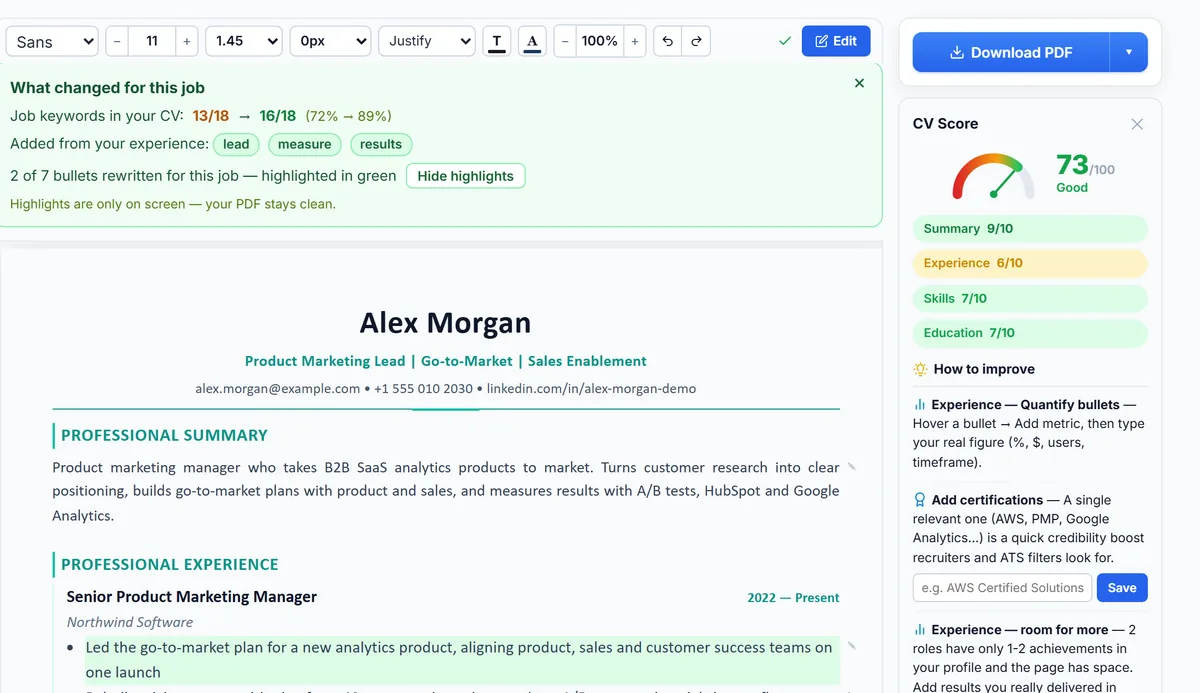
The fix isn't a one-page summary at the top that says "transitioning to UX". It's a full rewrite that re-frames your experience in the new industry's language. This guide walks through what to keep, what to cut, what to translate, and how AI tools cut the tedious rewriting from hours per application to seconds.
The mistake: keeping the same resume and adding a headline
The most common career-change resume opens with a 3-line headline ("Marketing manager transitioning to product management") then proceeds to list 8 years of marketing experience verbatim. Recruiters read the headline, then skim the experience, see no product titles or metrics, and pass. The headline doesn't earn enough credit to overcome the bulk of "wrong industry" experience below it.
What actually works: rewrite the bullets so they describe the skills you used (which are often transferable) using the new industry's vocabulary.
Step 1: Identify transferable skills (not job titles)
List every skill you actually exercised in your current role — not the title, the underlying skills. A marketing manager's daily skills might include: stakeholder management, A/B testing, data analysis, copywriting, roadmap prioritisation, vendor management, cross-functional alignment.
Now look at 3 job postings in your target industry. Underline every skill they ask for. The overlap is your transferable foundation — that's what your resume needs to lead with.
Example mapping:
| Old role (Marketing) | New role (Product) |
|---|---|
| A/B testing landing pages | Product experimentation |
| Customer segmentation | User research / persona-building |
| Campaign prioritisation | Roadmap prioritisation |
| Channel ROI analysis | Feature impact analysis |
Step 2: Rewrite every bullet using the new industry's verbs
Each experience bullet should follow the same structure regardless of industry: verb + what you did + measurable outcome. The shift is in the verbs and nouns.
Before (marketing manager applying to product):
Managed paid acquisition campaigns across Google Ads and Meta, achieving 18% YoY growth in qualified leads.
After (rewritten for product):
Owned end-to-end performance experimentation across two acquisition surfaces; iterative testing drove an 18% YoY lift in qualified-lead conversion.
Same fact, different framing. "Owned end-to-end", "experimentation", "iterative testing", "conversion" are all product-team vocabulary. The 18% number stays — quantified impact is universally valuable.
Step 3: Add a Skills section ranked by relevance to the new role
A Skills section at the top of the resume (above Experience) is one of the highest-leverage edits for a career switch. ATS systems index it heavily, and recruiters skim it first.
For each target job posting, copy the required-skills list and put any matches in your Skills section — ordered with the strongest matches first. Drop any skills from your old role that aren't relevant.
Example for marketing → product:
SKILLS
A/B Testing & Experimentation · User Research · Roadmap Prioritisation
SQL · Mixpanel · Amplitude · Figma · Notion · Jira · Stakeholder Management
Note: only list skills you can actually defend in an interview. Listing "SQL" then bombing a SQL screening question is worse than not listing it.
Step 4: Build a 2-3 line Professional Summary that frames the pivot
The opening summary is the only place you should explicitly acknowledge the career change. Keep it short and lead with the outcome you'll deliver, not your background.
Template:
[New industry] [title] with [X years] of cross-functional experience in [old industry context]. Drove [specific outcome / metric] through [transferable skill set]. Currently focused on [target role focus area].
Example:
Product manager with 6 years of growth-marketing background driving experimentation, user research, and cross-functional execution. Owned the experimentation roadmap that grew qualified-lead conversion 18% YoY. Currently focused on B2B SaaS activation and retention.
Step 5: Make a small portfolio or proof project
One concrete artefact in the new industry beats five years of theoretical interest. Career-changers who get hired almost always have some demonstrable work in the new space:
- Engineer → PM: a product spec or PRD on a hypothetical feature for a company you'd want to work at.
- Marketing → Data analyst: a 5-page analysis of a public dataset (Kaggle, NYC Open Data) with SQL queries shown.
- Teaching → L&D: a short course (Notion / Loom) on a workplace skill.
- Finance → Product: a teardown of a fintech product's UX with proposed improvements.
Link to it from the resume header. Recruiters click these surprisingly often.
Step 6: Tailor per-application using AI
Doing the above for every application is exhausting if done manually — 15-20 minutes per job to rewrite bullets in the target industry's language. The whole point of automation is to compress this to seconds.
Workflow with AutoApplyMax:
- Upload your base resume (the one with the marketing/teaching/finance history).
- Paste the target job description (a product / data / L&D role).
- The AI rewrites each bullet to mirror the JD's vocabulary and adds the Skills section with relevant matches.
- Run the result through the ATS Score Checker to confirm 80%+ keyword match.
- Download the PDF, apply.
Free tier: 1 tailored CV per month. Try it free.
Career-change cover letter: 3 paragraphs only
For career switchers, the cover letter is more important than for in-industry candidates (because the resume alone doesn't tell the full story). Keep it to three paragraphs:
- Why this company specifically — one sentence that proves you researched them beyond the JD.
- The single most relevant transferable experience with one quantified outcome that maps to a stated requirement.
- Forward-looking: what you'd bring in the first 30 days, framed in their language, not yours.
Use the AutoApplyMax AI Cover Letter generator — paste the JD and your CV, get a tailored cover letter in 20 seconds, edit the personal-touch sentences. Read more on cover letter structure.
Career change resume examples by switch
The method above works for any pivot, but the vocabulary changes with every destination. Below are five common moves in the US and Canadian job market, with the skills that transfer, the target title to use in your summary and one rewritten bullet. Each links to full resume examples and a keyword list for the target role, so you can see what the finished resume and the posting's vocabulary look like.
Teacher → HR generalist or corporate trainer
Skills that transfer: training design, presenting to groups, documentation, parent and stakeholder communication, handling sensitive conversations, record keeping.
Before: "Taught 6th-grade math to five classes and met with parents."
After: "Designed and delivered weekly lessons for five groups of learners, tracked progress in a shared gradebook and ran parent conferences on performance and behavior plans."
See HR generalist resume examples and HR generalist resume keywords, and for the classroom side, teacher resume examples.
Retail store manager → operations manager
Skills that transfer: scheduling and staffing, inventory control, P&L responsibility, vendor coordination, hiring and training, health and safety.
Before: "Managed the store and the staff."
After: "Ran daily operations for a store with [number] employees: built weekly schedules against sales forecasts, managed inventory counts and vendor deliveries, and owned the store budget."
See operations manager resume examples and operations manager keywords. If you want to stay in retail leadership, compare with store manager examples.
Accountant or finance → data analyst
Skills that transfer: Excel modeling, reconciliations, reporting deadlines, variance analysis, explaining numbers to non-finance managers.
Before: "Prepared monthly financial reports."
After: "Built the monthly variance report in Excel (pivot tables, Power Query) from ERP exports and walked department heads through the drivers behind each change."
See data analyst resume examples and data analyst keywords. Add SQL or a BI tool only once you have actually used it — a small project counts.
Customer service → IT support specialist
Skills that transfer: ticket handling, troubleshooting scripts, de-escalation, documenting fixes, working to response-time targets.
Before: "Helped customers with problems on the phone."
After: "Resolved account and connectivity issues by phone and chat, logged every case in Zendesk and wrote knowledge-base articles for recurring fixes."
See IT support specialist resume examples and IT support keywords; an entry-level certification is the usual bridge here, see our free IT support certifications.
Military, hospitality or events → project manager
Skills that transfer: planning under deadlines, coordinating teams and suppliers, budgets, risk planning, status reporting.
Before: "Organized events for the hotel."
After: "Planned and delivered corporate events from contract to wrap-up: built timelines, coordinated catering, AV and venue teams, and tracked each event against its budget."
See project manager resume examples and project manager keywords; the free project management certifications list covers the usual entry credentials.
A hybrid resume template for career changers
A purely functional resume (skills only, no timeline) tends to make recruiters suspicious, and some applicant tracking systems parse it poorly. A hybrid layout keeps the full work history but puts the evidence for the new role first:
[Full name]
[City, State/Province] · [Phone] · [Email] · [LinkedIn URL] · [Portfolio link, if any]
SUMMARY
[Target title] with [number] years of [old field] experience in [two transferable skills]. [One result that proves the transferable skill]. [Course, certificate or project in the new field].
SKILLS
[5-8 skills from the target posting that you can prove, in the posting's spelling]
RELEVANT PROJECTS (optional)
[Project name] | [tools] | [date] — [what you built and what it shows]
EXPERIENCE
[Title] — [Employer], [City] | [Start] – [End]
- [Bullet rewritten in the new field's vocabulary]
- [Bullet rewritten in the new field's vocabulary]
EDUCATION & CERTIFICATIONS
[Degree], [School] | [Certificate], [Issuer], [Year]
Keep your real job titles. If a title means nothing in the new field, you can add a short clarification after it, for example "Shift Supervisor (team of 12, scheduling and training)". Check the result in the free resume checker and keep it to one or two pages with the resume length checker.
Career change summary: 4 fill-in examples
The summary is where the pivot is framed. Use one of these structures and replace every bracket with a real fact:
- Skill-led: "[Target title] with [number] years of [transferable skill] experience in [old industry], now applying it to [new field]. [Proof: result or project]."
- Credential-led: "Recently completed [certificate / bootcamp] in [new field] after [number] years in [old field], where I [transferable achievement]."
- Industry-bridge: "[Old role] moving into [new role] within [same industry], bringing first-hand knowledge of [customers / regulations / operations] that [new team] serves."
- Project-led: "[New-field] practitioner with a portfolio of [number] projects, including [best project], backed by [number] years of [old field] experience in [skill]."
If you prefer a draft to edit, the free resume summary generator writes one from your background; then check that every claim is true. To test whether your bullets read as strong evidence, run them through the resume bullet point checker.
How to list a bootcamp, certificate or course
Training in the new field is often your strongest signal, so list it clearly and in the right place:
- Put it in a Certifications or Education & Training section, with the issuer and the year: "Google Data Analytics Professional Certificate — Coursera, 2026".
- If the course included a real project, also list that project under Relevant Projects with the tools used.
- Mention an in-progress program with an expected date ("expected June 2027") rather than leaving it off.
- Skip short courses that are not related to the target role; they dilute the ones that are.
US and Canada notes for career changers
The resume rules for a career change are the same on both sides of the border: no photo, no date of birth, one or two pages, reverse-chronological experience. A few practical differences matter more for career changers:
- Regulated professions. Some destinations require a license that is issued by a state (US) or by a provincial regulatory body (Canada) — nursing, engineering, accounting designations, teaching, many trades. Check the requirement before you rewrite your resume, and list the licensing step you are working on.
- Job titles. The same work can carry different titles: "Software Developer" is common in Canadian postings, "Software Engineer" in US ones. Mirror the posting's wording in your summary.
- Bilingual roles. In Quebec and in many federal public-service roles, French can be a requirement or an asset — state your level clearly if the posting mentions it.
For layout differences between the two countries, see Canadian resume format vs US resume.
What NOT to do
- Don't apologise for the pivot in your summary ("While I haven't worked in product directly, I'm passionate about…"). Recruiters read this as low confidence.
- Don't list every old skill just because you have it. A 12-line Skills section dilutes the relevant ones.
- Don't oversell self-taught. "Self-taught in Python (3 months)" is fine; "Expert in Python" after 3 months is not.
- Don't apply to senior roles in the new field in your first batch. Start at one level junior to your old role and move up after 12-18 months.
Tailor your resume for the new industry in 30 seconds
AutoApplyMax's AI Resume generator rewrites your bullets using the target job's vocabulary, adds matching skills, and exports an ATS-friendly PDF. 1 free tailoring per month.
Tailor My Resume FreeFAQ: career change resumes
Should I use a functional resume for a career change?
Usually not a purely functional one. Recruiters want to see where and when you used your skills, and some applicant tracking systems parse skills-only resumes poorly. A hybrid resume works better: a summary and skills section aimed at the new role, followed by your full work history with bullets rewritten in the new field's vocabulary.
How do I explain a career change on my resume?
In one place only: the summary. Name the target role, the transferable skills and one piece of proof, such as a result, a certificate or a project. The rest of the resume should simply show the evidence, without apologizing for the switch.
What job title should I put on my resume when changing careers?
Keep your real past job titles, because they can be verified. Use the target title in your summary ("Data analyst with five years of finance reporting experience") and, if a past title is unclear, add a short description in parentheses after it.
Do I need a cover letter for a career change?
It helps more than usual, because the resume alone does not explain the move. Keep it to three short paragraphs: why this company, the most relevant transferable result, and what you would bring to the team. The AI cover letter writer can draft it from your resume and the job description.
How far back should a career change resume go?
Around 10 to 15 years of experience is enough for most roles. Older jobs can be shortened to one line or grouped under "Earlier experience", unless they are directly relevant to the new field.
Related Reading
- 15 ATS Resume Tips That Actually Work
- How to Optimize Your LinkedIn Profile in 2026
- Top AI Job-Search Tools for 2026
- How to Write a Resume with No Experience
Want to see this applied to a full resume? Our resume examples by job title show complete samples at entry, mid and senior level, for example for data analyst, project manager and UX designer roles.