Short version: your resume tells a recruiter what you did; your cover letter tells them why it matters to this specific role. They're complementary, not redundant. In 2026, ~60% of job postings ask for both, ~35% ask only for a resume, and ~5% require a different format (work sample, portfolio link, video).
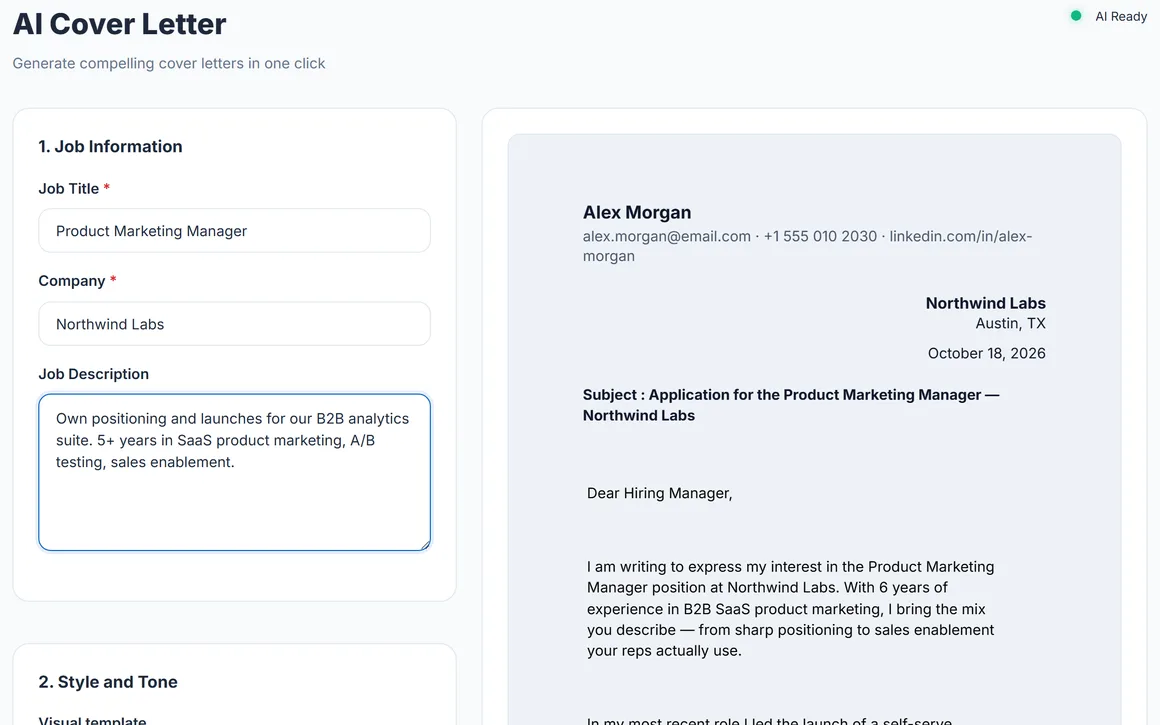
But should you send a cover letter when it's marked "optional"? When is it a waste of time? And how do you write each one in under 5 minutes per application? This guide gives concrete rules + the workflow that turns both into a 30-second per-application task.
The core difference
| Resume | Cover Letter |
|---|---|
| Standardised structure: Summary, Experience, Education, Skills | Free-form prose, 3-4 paragraphs |
| One page (or two if 10+ years experience) | Under 300 words |
| Same document, lightly tailored per job | Should be rewritten per job |
| Parsed by ATS for keywords | Mostly read by humans (recruiters skim) |
| What you did + measurable outcomes | Why YOU for THIS role, not generic enthusiasm |
When you absolutely need a cover letter
- The posting explicitly requires one. Skip at your peril — many ATS auto-reject incomplete applications.
- Career switch. The cover letter is where you explain the pivot (the resume can't easily).
- Gap in employment. Address it briefly in the cover letter, not the resume.
- Returning from a break (parental, health, sabbatical).
- Highly competitive role (well-paid, well-known company) where every signal counts.
- Senior or executive roles — cover letter is expected even when not required.
When you can skip the cover letter
- The posting says "optional" AND you've already written a tailored resume. Most recruiters don't read optional cover letters — a 2024 LinkedIn survey put the read-rate at 22%.
- High-volume sourcing roles (sales, customer support, retail) where recruiters work from filters not narrative.
- You're applying through a referral. A 3-line note to the referrer's recruiter beats a formal cover letter.
- You don't have time to tailor it. A generic copy-paste cover letter actively hurts you. Better to omit than to send a bad one.
Anatomy of a resume that works in 2026
A modern resume has 4-5 sections in this order:
- Header: name, contact, LinkedIn URL, portfolio/Github if relevant. No photo (outside FR/DE/CH).
- Professional Summary: 2-3 lines. Title you want + transferable strength + outcome.
- Experience: reverse-chronological. 3-5 bullets per role, each verb + action + quantified outcome.
- Skills: hard skills only (tools, languages, methodologies). Avoid "team player".
- Education + Certifications: stacked at the bottom for experienced candidates.
Verify it parses through ATS — use the free ATS Score Checker before submitting.
Deeper dive: ATS Resume Tips and What Recruiters Look For.
Anatomy of a cover letter that works in 2026
Three paragraphs, ~250 words total:
- Paragraph 1 — Why this company specifically. One sentence that shows you read beyond the JD (a recent product, a value, a public win). Then state the role and why you're a strong fit in one sentence.
- Paragraph 2 — One concrete achievement with a measurable outcome that maps directly to a stated requirement in the JD. Don't summarise your resume — pick the single most relevant story.
- Paragraph 3 — Forward-looking. What you'd bring in the first 30-60 days. End with a clear call ("happy to walk through this in more depth").
Skip: "I am thrilled to apply", "I believe my skills align", listing every responsibility from your CV, generic enthusiasm.
Generic AI cover letters are getting recruiters to skip you
Recruiters in 2026 pattern-match generic ChatGPT output instantly. Common giveaways:
- "I am thrilled to apply for the [Role] position at [Company]."
- Three bullet points of vague responsibilities.
- "I believe my skills align perfectly with your needs."
- Em-dashes everywhere (a ChatGPT tic).
If you use AI to draft your cover letter, always edit it — replace generic openings with company-specific hooks, swap vague claims for specific stories, cut anything that could apply to any other job. AutoApplyMax's AI Cover Letter generator is prompt-engineered to skip these patterns: it pulls the company name + JD specifics into the opening and forces a concrete outcome in paragraph 2. Result: 250-word letter, ~20 seconds, no editing required for ~70% of cases.
The 30-second-per-application workflow
- Upload your base resume to AutoApplyMax once.
- For each job: paste the JD → AI Resume generator outputs a tailored CV (30 sec).
- Same JD → AI Cover Letter generator outputs a tailored cover letter (20 sec).
- Quick visual check (10 sec): does the opening hook reference the company? Does paragraph 2 mention a specific outcome?
- Download both → submit.
Free tier: 1 generation/month (one CV or one cover letter). Premium tier at $6.99/mo gives 30/month — enough for ~15 well-tailored applications.
FAQ
Q: Should I include a cover letter when LinkedIn Easy Apply doesn't ask for one?
A: No. Easy Apply doesn't surface cover letters even when uploaded — they go into a separate "attachments" tab that recruiters rarely open. Save it for company career pages.
Q: How long should a cover letter be?
A: 200-300 words. Anything longer doesn't get read.
Q: Do recruiters actually read cover letters?
A: ~22% read optional ones, ~70% read required ones, ~95% read them when the role is senior or competitive.
Q: Can the same cover letter work for multiple jobs?
A: Only if you change paragraph 1 (the company-specific hook) and paragraph 2 (the matched achievement) for each. Paragraph 3 can stay similar.
Tailored CV + cover letter per job in 50 seconds
AutoApplyMax generates both your CV and cover letter from one job description in under a minute. Free tier covers 2 full applications per month.
Generate Both Free