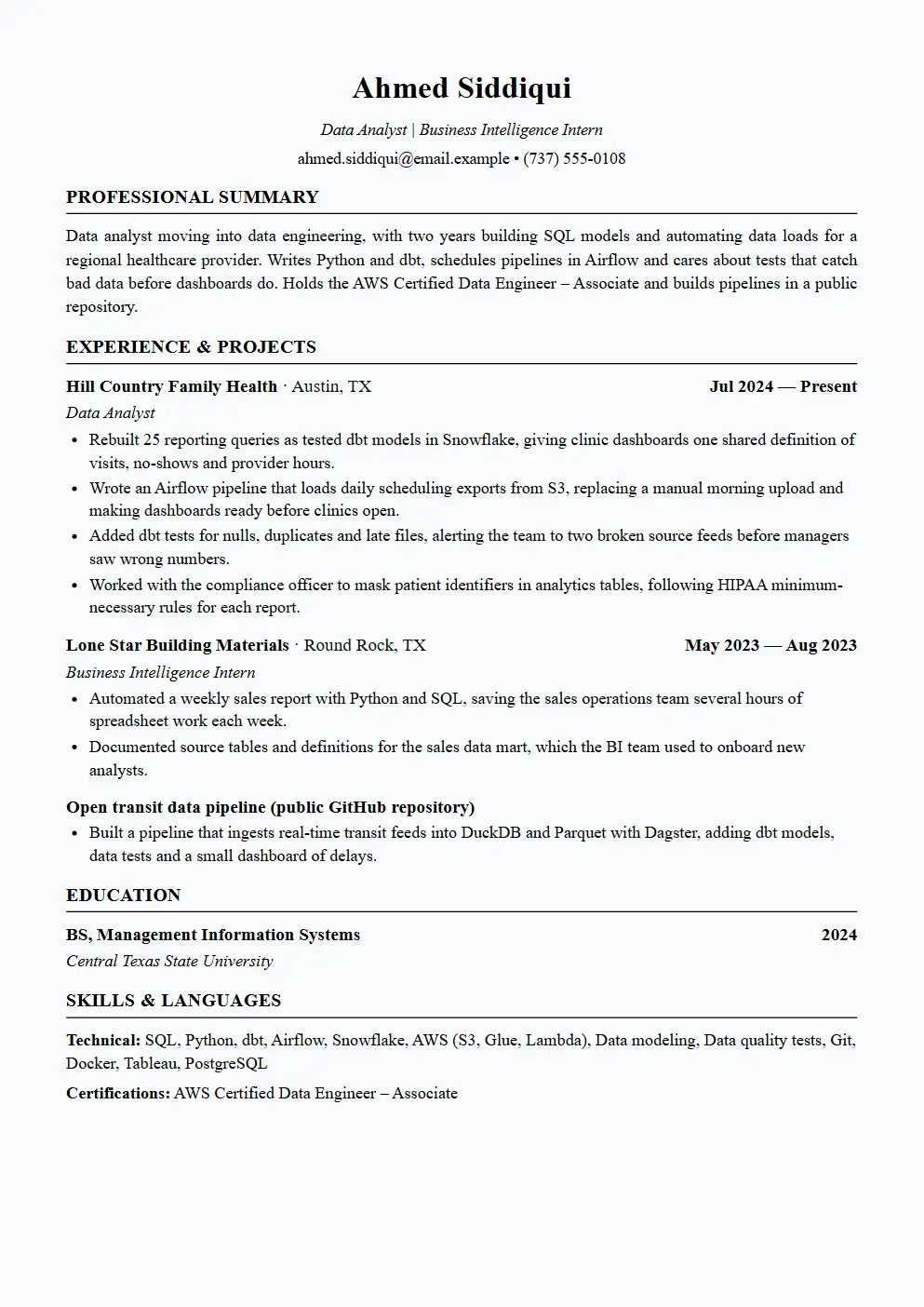
Ahmed Siddiqui: Data Analyst
Ahmed is moving from analyst to engineer, so his bullets emphasize engineering work inside an analyst job: dbt models with tests, an Airflow pipeline, alerts and data masking. His public pipeline project shows orchestration and testing outside work. The AWS data engineering certification supports the transition, which hiring managers often question for analysts.
Read this resume as text
Ahmed Siddiqui · Austin, TX · ahmed.siddiqui@email.example · (737) 555-0108
Summary
Data analyst moving into data engineering, with two years building SQL models and automating data loads for a regional healthcare provider. Writes Python and dbt, schedules pipelines in Airflow and cares about tests that catch bad data before dashboards do. Holds the AWS Certified Data Engineer – Associate and builds pipelines in a public repository.
Experience
Data Analyst, Hill Country Family Health · Austin, TX · Jul 2024 — Present
- Rebuilt 25 reporting queries as tested dbt models in Snowflake, giving clinic dashboards one shared definition of visits, no-shows and provider hours.
- Wrote an Airflow pipeline that loads daily scheduling exports from S3, replacing a manual morning upload and making dashboards ready before clinics open.
- Added dbt tests for nulls, duplicates and late files, alerting the team to two broken source feeds before managers saw wrong numbers.
- Worked with the compliance officer to mask patient identifiers in analytics tables, following HIPAA minimum-necessary rules for each report.
Business Intelligence Intern, Lone Star Building Materials · Round Rock, TX · May 2023 — Aug 2023
- Automated a weekly sales report with Python and SQL, saving the sales operations team several hours of spreadsheet work each week.
- Documented source tables and definitions for the sales data mart, which the BI team used to onboard new analysts.
Projects
Open transit data pipeline (public GitHub repository)
- Built a pipeline that ingests real-time transit feeds into DuckDB and Parquet with Dagster, adding dbt models, data tests and a small dashboard of delays.
Education
BS, Management Information Systems, Central Texas State University (2024)
Certifications
AWS Certified Data Engineer – Associate
Skills
SQL, Python, dbt, Airflow, Snowflake, AWS (S3, Glue, Lambda), Data modeling, Data quality tests, Git, Docker, Tableau, PostgreSQL
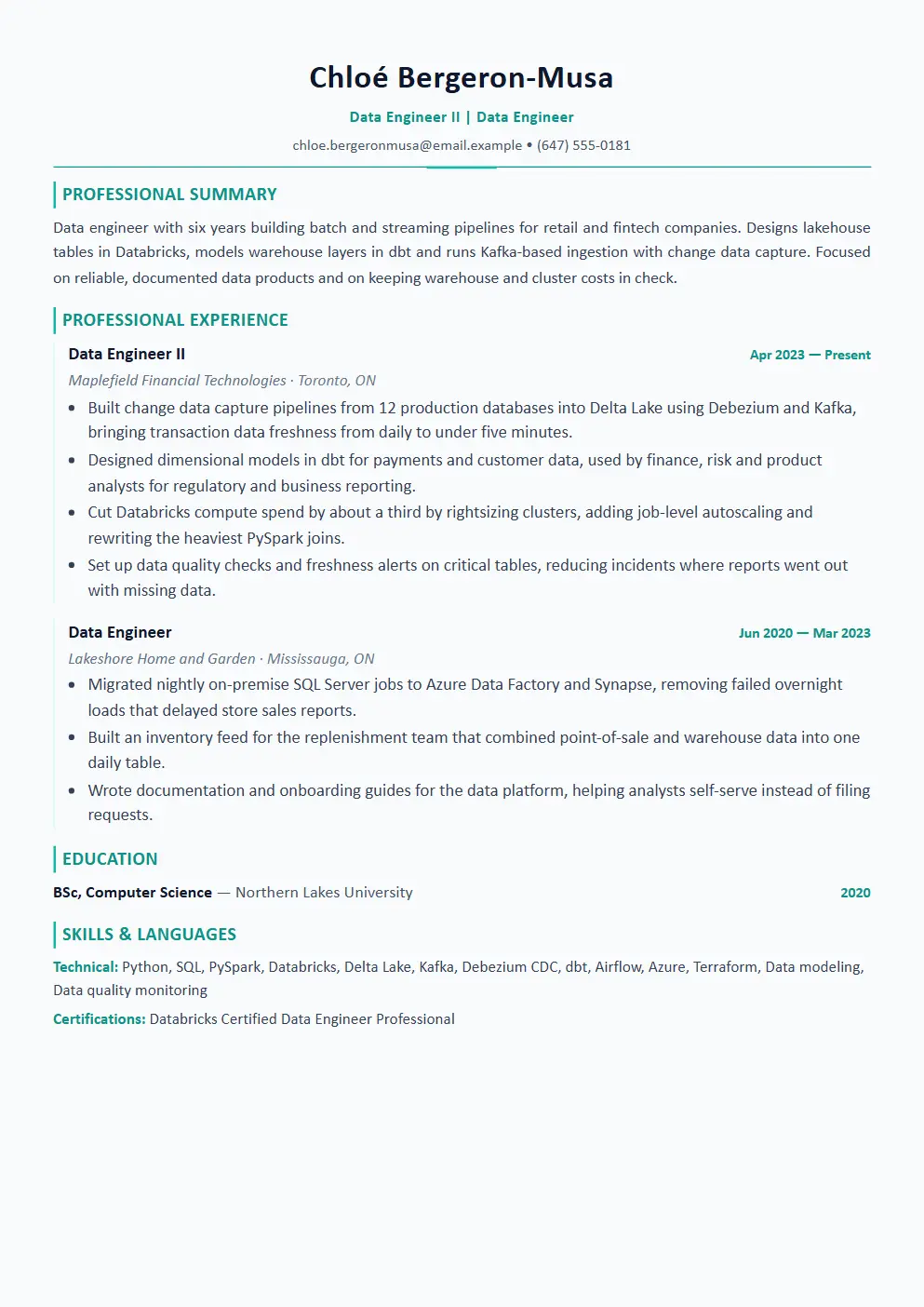
Chloé Bergeron-Musa: Data Engineer II
Chloé's bullets show scale and reliability: CDC from many databases, freshness gains, dimensional models used across teams, cost cuts and data quality checks. Naming Databricks, Kafka and dbt in context shows real depth. Her migration from on-premise tools explains a common career path and shows she understands both legacy and modern stacks.
Read this resume as text
Chloé Bergeron-Musa · Toronto, ON · chloe.bergeronmusa@email.example · (647) 555-0181
Summary
Data engineer with six years building batch and streaming pipelines for retail and fintech companies. Designs lakehouse tables in Databricks, models warehouse layers in dbt and runs Kafka-based ingestion with change data capture. Focused on reliable, documented data products and on keeping warehouse and cluster costs in check.
Experience
Data Engineer II, Maplefield Financial Technologies · Toronto, ON · Apr 2023 — Present
- Built change data capture pipelines from 12 production databases into Delta Lake using Debezium and Kafka, bringing transaction data freshness from daily to under five minutes.
- Designed dimensional models in dbt for payments and customer data, used by finance, risk and product analysts for regulatory and business reporting.
- Cut Databricks compute spend by about a third by rightsizing clusters, adding job-level autoscaling and rewriting the heaviest PySpark joins.
- Set up data quality checks and freshness alerts on critical tables, reducing incidents where reports went out with missing data.
Data Engineer, Lakeshore Home and Garden · Mississauga, ON · Jun 2020 — Mar 2023
- Migrated nightly on-premise SQL Server jobs to Azure Data Factory and Synapse, removing failed overnight loads that delayed store sales reports.
- Built an inventory feed for the replenishment team that combined point-of-sale and warehouse data into one daily table.
- Wrote documentation and onboarding guides for the data platform, helping analysts self-serve instead of filing requests.
Education
BSc, Computer Science, Northern Lakes University (2020)
Certifications
Databricks Certified Data Engineer Professional
Skills
Python, SQL, PySpark, Databricks, Delta Lake, Kafka, Debezium CDC, dbt, Airflow, Azure, Terraform, Data modeling, Data quality monitoring
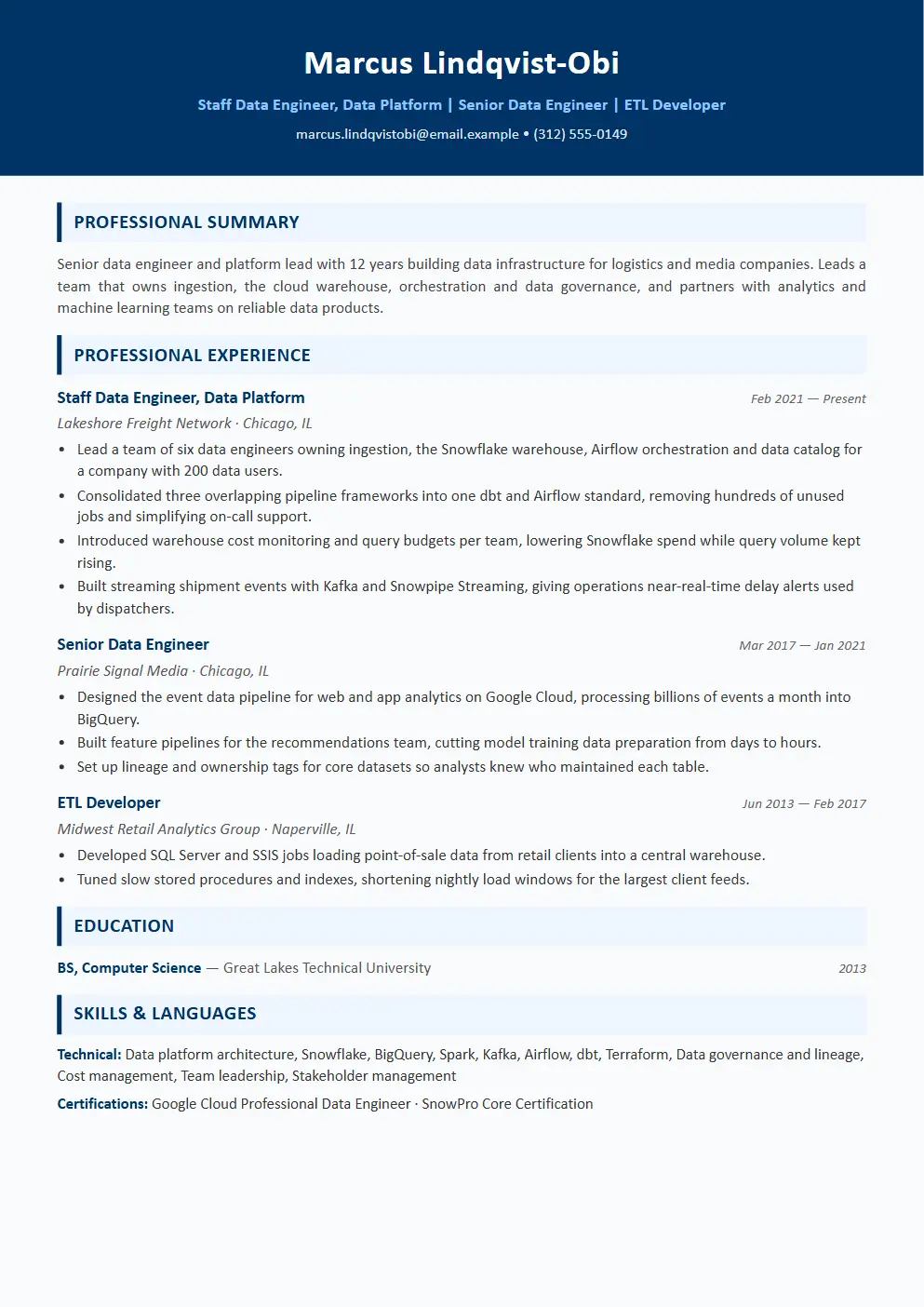
Marcus Lindqvist-Obi: Staff Data Engineer, Data Platform
Marcus is presented as a platform owner: team size, consolidation of frameworks, cost governance and streaming for operations. His earlier roles show progression from ETL developer to cloud data platforms, which explains his judgment about simplifying pipelines. Two cloud data certifications fit his multi-cloud background without crowding the summary.
Read this resume as text
Marcus Lindqvist-Obi · Chicago, IL · marcus.lindqvistobi@email.example · (312) 555-0149
Summary
Senior data engineer and platform lead with 12 years building data infrastructure for logistics and media companies. Leads a team that owns ingestion, the cloud warehouse, orchestration and data governance, and partners with analytics and machine learning teams on reliable data products. Known for simplifying sprawling pipelines and making data costs predictable.
Experience
Staff Data Engineer, Data Platform, Lakeshore Freight Network · Chicago, IL · Feb 2021 — Present
- Lead a team of six data engineers owning ingestion, the Snowflake warehouse, Airflow orchestration and data catalog for a company with 200 data users.
- Consolidated three overlapping pipeline frameworks into one dbt and Airflow standard, removing hundreds of unused jobs and simplifying on-call support.
- Introduced warehouse cost monitoring and query budgets per team, lowering Snowflake spend while query volume kept rising.
- Built streaming shipment events with Kafka and Snowpipe Streaming, giving operations near-real-time delay alerts used by dispatchers.
Senior Data Engineer, Prairie Signal Media · Chicago, IL · Mar 2017 — Jan 2021
- Designed the event data pipeline for web and app analytics on Google Cloud, processing billions of events a month into BigQuery.
- Built feature pipelines for the recommendations team, cutting model training data preparation from days to hours.
- Set up lineage and ownership tags for core datasets so analysts knew who maintained each table.
ETL Developer, Midwest Retail Analytics Group · Naperville, IL · Jun 2013 — Feb 2017
- Developed SQL Server and SSIS jobs loading point-of-sale data from retail clients into a central warehouse.
- Tuned slow stored procedures and indexes, shortening nightly load windows for the largest client feeds.
Education
BS, Computer Science, Great Lakes Technical University (2013)
Certifications
Google Cloud Professional Data Engineer · SnowPro Core Certification
Skills
Data platform architecture, Snowflake, BigQuery, Spark, Kafka, Airflow, dbt, Terraform, Data governance and lineage, Cost management, Team leadership, Stakeholder management
Tailor this resume to a job in 30 seconds
Paste a real data engineer posting and AutoApplyMax rewrites your own resume for it: same facts, reordered and rephrased around what that employer asks for. The free plan includes 1 tailored resume a month.
How to write each section of a data engineer resume
Header and repositories
List name, city, email, phone, LinkedIn and GitHub. A public pipeline project is helpful, especially when moving from analyst roles: show ingestion, orchestration, tests and a clear README describing design choices and data volumes.
Never publish employer data, credentials or schema details that could identify customers. Use open datasets for personal projects, and say in the README how much data the pipeline handles and how often it runs.
Summary
State your years of experience, your main cloud and warehouse, your processing tools and the data domains you know, such as payments, healthcare, retail or advertising. Mention batch, streaming or both, since postings often specify one.
Add a line on what you are known for, such as reliability, cost management, modeling or platform simplification. Avoid listing every tool in the summary; save that for the skills section.
Experience
Good data engineering bullets mention data sources, volume or scale, tools and outcomes. Useful outcomes include data freshness, pipeline reliability, incidents reduced, query speed, compute cost, analyst time saved and adoption by other teams.
Show who used your data: analysts, finance, product, machine learning or operations. That context proves your pipelines served real needs and helps hiring managers judge whether you understand stakeholders.
Skills
Group skills into languages, processing and streaming, warehouses and lakehouses, orchestration and transformation, cloud and infrastructure, and quality and governance. SQL and Python are expected; Scala or Java helps for Spark-heavy and streaming roles.
List tools you have used in production or serious projects. Interviewers often ask about specific trade-offs, such as partitioning, incremental models or late-arriving data, so be ready to explain every choice you list.
Education and certifications
Computer science, information systems, statistics and engineering degrees are common, but analysts and software engineers move into data engineering regularly. Keep education short after a few years of experience.
Cloud data certifications from AWS, Google Cloud, Microsoft, Databricks or Snowflake help, especially for career changers and consultants. List the issuer and keep only current certifications, since several vendors retire and replace exams over time.
Data Engineer resume summary examples
Entry-level objective: Data analyst seeking a junior data engineer role on a team that runs pipelines in Airflow and dbt. Brings two years of SQL modeling, an automated S3-to-Snowflake load in production, data quality tests and an AWS data engineering certification.
It shows the transition is already underway, with production work rather than only coursework.
New-grad summary: Computer science graduate with a data engineering co-op building Python ingestion jobs and dbt models on BigQuery. Comfortable with SQL performance basics, Git workflows and Docker, and has a public pipeline project with orchestration and tests.
It names a modern stack and shows production exposure plus independent work.
Mid-level summary: Data engineer with six years building batch and streaming pipelines in retail and fintech. Designs Delta Lake and dbt models, runs Kafka CDC ingestion and keeps platforms reliable with data quality checks and cost controls. Comfortable owning pipelines end to end.
It covers data types, tools, reliability and cost, which mid-level postings consistently ask about.
Senior summary: Staff data engineer leading a data platform team in logistics, with 12 years across ingestion, warehousing and governance. Consolidates pipeline sprawl into clear standards, manages warehouse costs and builds streaming data products used in daily operations.
It shows leadership, platform thinking and business-facing outcomes rather than tool lists.
Data Engineer resume bullet examples: weak vs strong
The strong versions use made-up figures for a fictional candidate. Replace them with your own real numbers, or describe the scope (team size, volume, frequency) if you have none.
Source count, tools and a freshness result show both scale and value.
Shows who uses the models and why consistency mattered.
Connects orchestration to a daily business need instead of describing the tool.
Shows concrete checks and the problem they prevented.
Specific techniques make a cost claim believable and easy to discuss.
Before and after states plus a business effect show why the migration mattered.
Names the users and the operational value of streaming, not just the technology.
Shows leadership through simplification, a key signal for staff and lead roles.
Keywords from live data engineer job postings
We read 212 live data engineer postings (38 US and 174 Canadian) from our job feed on October 14, 2026 and counted how many mention each skill, tool or credential. A posting counts once per term, wherever it appears in the title or description. Use the list to check your resume for gaps that are real for you, not as a checklist.
| Keyword | Postings | |
|---|---|---|
| SQL | 156 of 212 (74%) | |
| Python | 154 of 212 (73%) | |
| Data pipelines | 124 of 212 (58%) | |
| ETL / ELT | 104 of 212 (49%) | |
| Data modeling | 104 of 212 (49%) | |
| Data quality | 99 of 212 (47%) | |
| Data governance | 99 of 212 (47%) | |
| Spark | 90 of 212 (42%) | |
| Azure | 83 of 212 (39%) | |
| Databricks | 76 of 212 (36%) | |
| CI/CD | 75 of 212 (35%) | |
| Streaming | 73 of 212 (34%) | |
| AWS | 62 of 212 (29%) | |
| Data warehouse | 61 of 212 (29%) | |
| Computer Science degree | 61 of 212 (29%) | |
| Snowflake | 58 of 212 (27%) | |
| Machine learning support | 53 of 212 (25%) | |
| Airflow | 46 of 212 (22%) | |
| Git | 46 of 212 (22%) | |
| dbt | 41 of 212 (19%) | |
| Azure Data Factory | 41 of 212 (19%) | |
| BI tools | 41 of 212 (19%) |
Source: 212 unique postings whose title matches the role, from the WhatJobs publisher feed (US and Canada), collected October 14, 2026. Duplicate reposts were counted once. Counts change daily; a term not listed may still matter for a specific employer.
Skills for a data engineer resume
Languages and processing
- SQL
- Python
- PySpark
- Scala
- Kafka
- Flink
Show SQL depth through modeling or tuning, not just querying.
Storage and warehousing
- Snowflake
- BigQuery
- Redshift
- Databricks
- Delta Lake or Iceberg
- PostgreSQL
Lead with the warehouse the posting names, and mention scale where you can.
Orchestration and transformation
- Airflow
- Dagster
- dbt
- Fivetran or Airbyte
- Azure Data Factory
- AWS Glue
Show you build maintainable, tested pipelines rather than one-off scripts.
Platform and governance
- Terraform
- Docker
- CI/CD
- Data quality testing
- Data catalog and lineage
- Access controls
These matter more at mid and senior levels, where reliability and compliance are part of the job.
Soft skills, and how to prove them
- Stakeholder understanding: Describe a dataset you built after talking to analysts or business users, and how they used it.
- Reliability mindset: Show alerts, tests or runbooks you added and the incidents or bad reports they prevented.
- Documentation: Mention data dictionaries, onboarding guides or README files you wrote that helped others self-serve.
- Pragmatism: Give an example of choosing a managed connector or simpler design over custom code, and what it saved.
- Mentoring: Name engineers or analysts you helped learn dbt, Spark or pipeline best practices.
Certifications and licenses
- Google Cloud Professional Data Engineer (Google Cloud): Well recognized for data engineers on BigQuery and Google Cloud data services.
- AWS Certified Data Engineer – Associate (Amazon Web Services): Covers ingestion, transformation and storage on AWS; a good fit for engineers early in their data careers.
- Databricks Certified Data Engineer Associate or Professional (Databricks): Shows practical Spark and lakehouse skill on the Databricks platform.
- SnowPro Core Certification (Snowflake): Validates Snowflake fundamentals; advanced SnowPro data engineer exams exist for deeper specialization.
- Microsoft Certified: Fabric Data Engineer Associate (Microsoft): Relevant for teams building data pipelines and lakehouses in Microsoft Fabric.
Looking for low-cost options? See our list of free certifications in this field.
US vs Canada: data engineer resumes and pay
United States
In the US, data engineer is an unregulated title. Healthcare, finance and public companies often ask about HIPAA, SOX or PCI DSS data handling, so mention access controls, masking or audit work if you have done it. State privacy laws such as California's add requirements on personal data, which matters for deletion and retention pipelines. Government and defense data roles may require citizenship and a clearance. Leave out photo, age and marital status, and address sponsorship in the application form.
| BLS occupation | 10th pct. | Median | 90th pct. |
|---|---|---|---|
| Database Architects (SOC 15-1243) closest BLS category | $86,240 | $139,500 | $204,000 |
Annual wages, US national, BLS Occupational Employment and Wage Statistics, May 2025.
Canada
In Canada, engineer is a regulated title in every province, and enforcement against software and data titles varies, so keep your employer's title on job entries but avoid calling yourself a professional engineer without a license. Privacy law includes PIPEDA federally and stricter rules in Quebec under Law 25, and many public sector and health employers expect data to stay in Canadian cloud regions. Experience with residency, masking and access controls is worth stating. Federal and Quebec roles may require French.
| Job Bank occupation | Low | Median | High |
|---|---|---|---|
| Data Engineer (NOC 21211) | $30.00/h | $46.15/h | $69.74/h |
Canada-wide wages in CAD, Job Bank (Government of Canada), reference period 2023-2024. Provincial figures differ; follow the link for your province.
Check your data engineer resume before you apply
The free ATS checker compares your resume with a real job description and lists the keywords you are missing. No signup needed for the scan.
FAQ
How do I move from data analyst to data engineer?
Show engineering work you already do: automated loads, tested SQL models, version control and scheduling. Add a public pipeline project with orchestration and tests, and consider a cloud data certification. Rewrite your resume bullets to lead with pipelines and reliability rather than dashboards.
What is the difference between a data engineer and an analytics engineer?
Data engineers usually own ingestion, infrastructure, orchestration and platform reliability. Analytics engineers focus on transforming and modeling data in the warehouse, often with dbt, so analysts can use it. Many roles blend both. Read the posting and emphasize the side it stresses.
Should I list every data tool I have used?
No. List the tools you have used in production or serious projects, grouped by category, and lead with what the posting asks for. A long list invites questions you may not answer well. Show the most important tools inside your bullets too.
How do I show data engineering impact without business metrics?
Use engineering outcomes: data freshness, pipeline success rates, incidents reduced, query speed, compute cost, analyst hours saved and teams onboarded. These are real results that hiring managers understand. If you know the business decision a dataset supported, add it.
Do data engineers need to know machine learning?
Not usually, but supporting machine learning teams is common. Experience building feature pipelines, training datasets or model monitoring data helps for roles near data science. Focus on reliable, well-modeled data first; that is the core of the job.