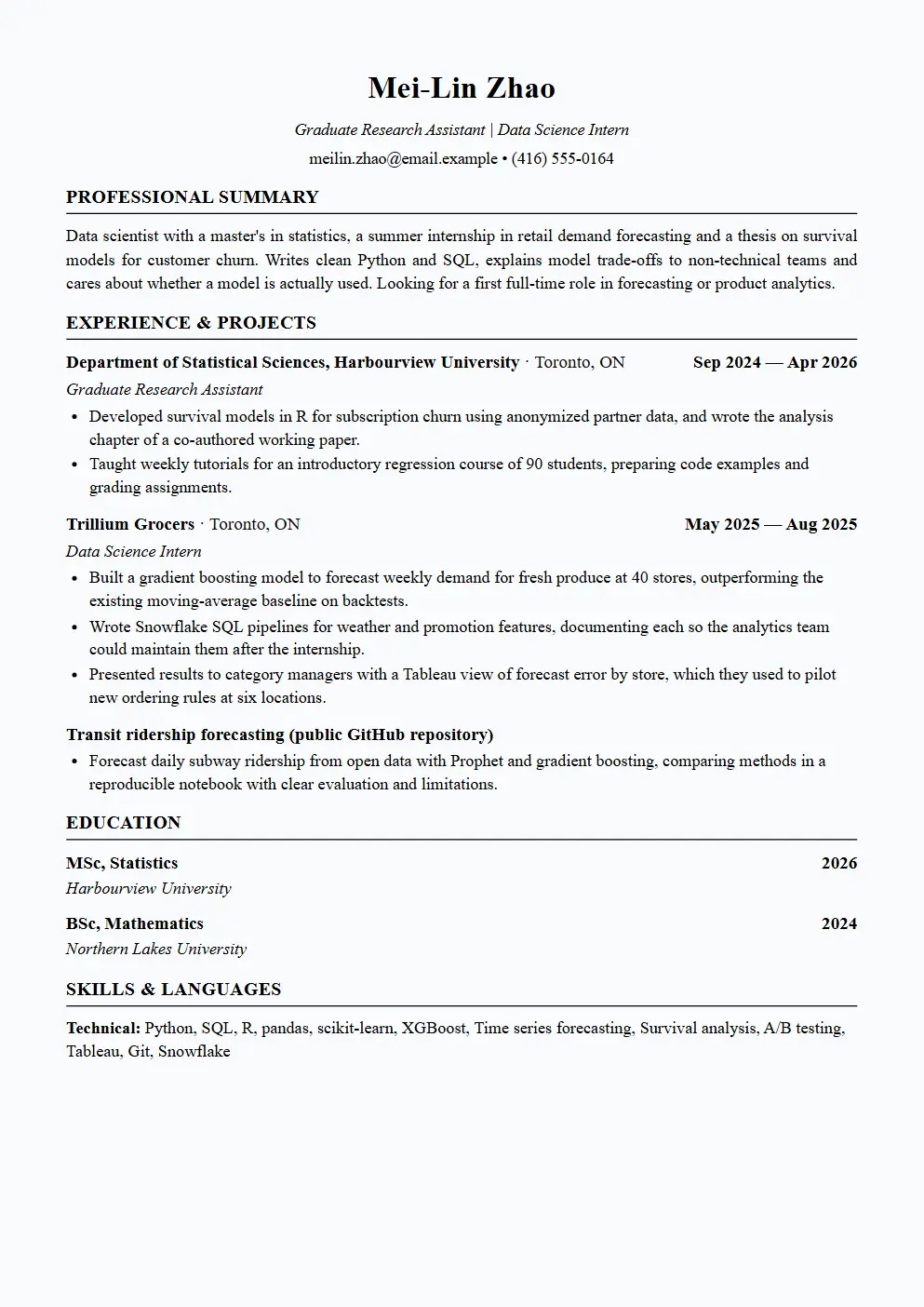
Mei-Lin Zhao: Data Science Intern
Mei-Lin's internship bullets show the full chain a junior data scientist rarely gets: a model, its data pipeline, evaluation against a baseline and a business pilot. Her research role proves statistical depth and communication through teaching. One public project shows reproducible work. No certifications appear, because for data science a strong degree, projects and code usually say more.
Read this resume as text
Mei-Lin Zhao · Toronto, ON · meilin.zhao@email.example · (416) 555-0164
Summary
Data scientist with a master's in statistics, a summer internship in retail demand forecasting and a thesis on survival models for customer churn. Writes clean Python and SQL, explains model trade-offs to non-technical teams and cares about whether a model is actually used. Looking for a first full-time role in forecasting or product analytics.
Experience
Data Science Intern, Trillium Grocers · Toronto, ON · May 2025 — Aug 2025
- Built a gradient boosting model to forecast weekly demand for fresh produce at 40 stores, outperforming the existing moving-average baseline on backtests.
- Wrote Snowflake SQL pipelines for weather and promotion features, documenting each so the analytics team could maintain them after the internship.
- Presented results to category managers with a Tableau view of forecast error by store, which they used to pilot new ordering rules at six locations.
Graduate Research Assistant, Department of Statistical Sciences, Harbourview University · Toronto, ON · Sep 2024 — Apr 2026
- Developed survival models in R for subscription churn using anonymized partner data, and wrote the analysis chapter of a co-authored working paper.
- Taught weekly tutorials for an introductory regression course of 90 students, preparing code examples and grading assignments.
Projects
Transit ridership forecasting (public GitHub repository)
- Forecast daily subway ridership from open data with Prophet and gradient boosting, comparing methods in a reproducible notebook with clear evaluation and limitations.
Education
MSc, Statistics, Harbourview University (2026)
BSc, Mathematics, Northern Lakes University (2024)
Skills
Python, SQL, R, pandas, scikit-learn, XGBoost, Time series forecasting, Survival analysis, A/B testing, Tableau, Git, Snowflake
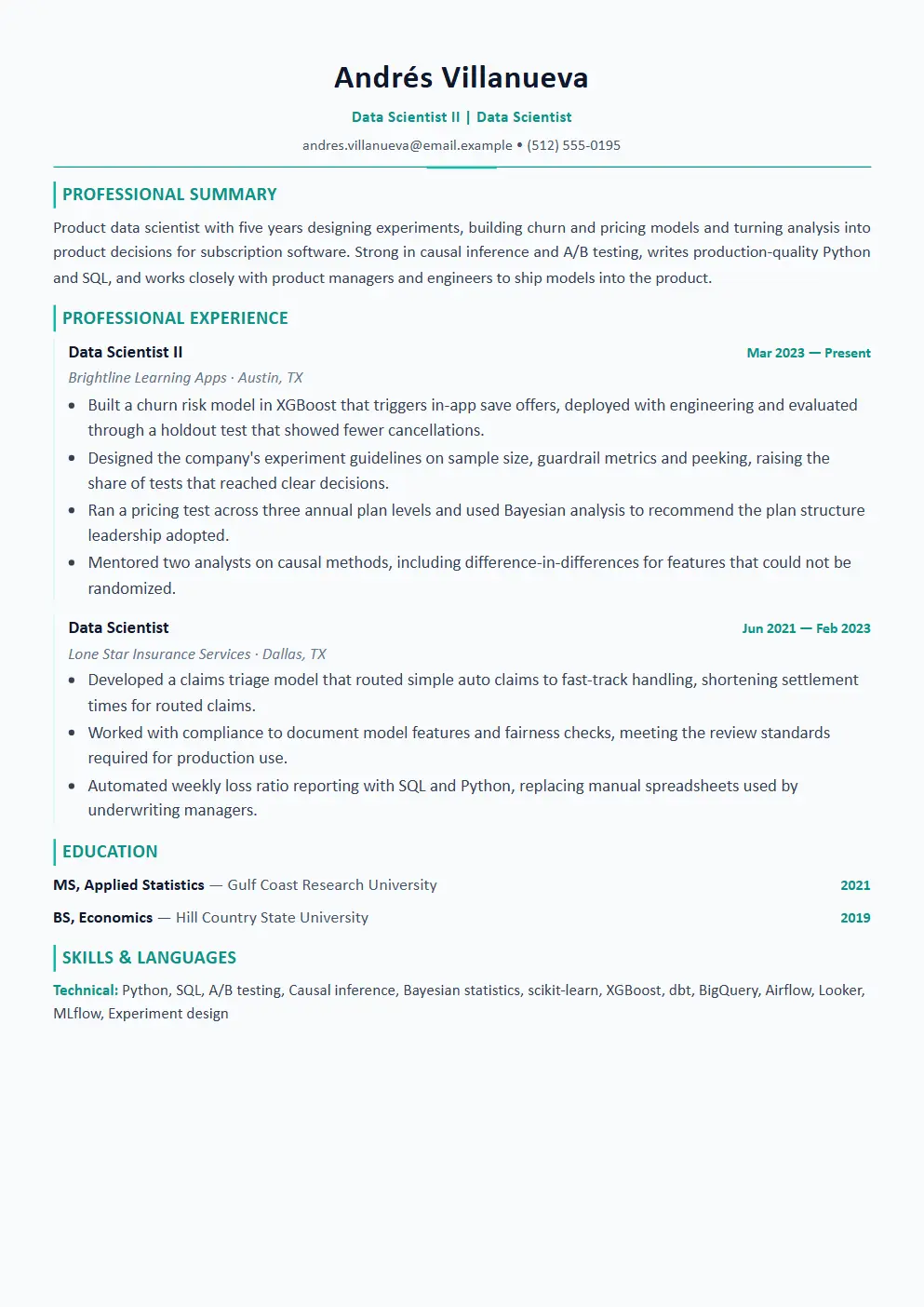
Andrés Villanueva: Data Scientist II
Andrés reads as a product data scientist: experiments, causal methods, pricing and a churn model that reached production. Each bullet names a decision or product change, not just a technique. His insurance role adds model governance and fairness documentation, useful for employers in regulated industries. Skills lean toward experimentation and the modern analytics stack.
Read this resume as text
Andrés Villanueva · Austin, TX · andres.villanueva@email.example · (512) 555-0195
Summary
Product data scientist with five years designing experiments, building churn and pricing models and turning analysis into product decisions for subscription software. Strong in causal inference and A/B testing, writes production-quality Python and SQL, and works closely with product managers and engineers to ship models into the product.
Experience
Data Scientist II, Brightline Learning Apps · Austin, TX · Mar 2023 — Present
- Built a churn risk model in XGBoost that triggers in-app save offers, deployed with engineering and evaluated through a holdout test that showed fewer cancellations.
- Designed the company's experiment guidelines on sample size, guardrail metrics and peeking, raising the share of tests that reached clear decisions.
- Ran a pricing test across three annual plan levels and used Bayesian analysis to recommend the plan structure leadership adopted.
- Mentored two analysts on causal methods, including difference-in-differences for features that could not be randomized.
Data Scientist, Lone Star Insurance Services · Dallas, TX · Jun 2021 — Feb 2023
- Developed a claims triage model that routed simple auto claims to fast-track handling, shortening settlement times for routed claims.
- Worked with compliance to document model features and fairness checks, meeting the review standards required for production use.
- Automated weekly loss ratio reporting with SQL and Python, replacing manual spreadsheets used by underwriting managers.
Education
MS, Applied Statistics, Gulf Coast Research University (2021)
BS, Economics, Hill Country State University (2019)
Skills
Python, SQL, A/B testing, Causal inference, Bayesian statistics, scikit-learn, XGBoost, dbt, BigQuery, Airflow, Looker, MLflow, Experiment design
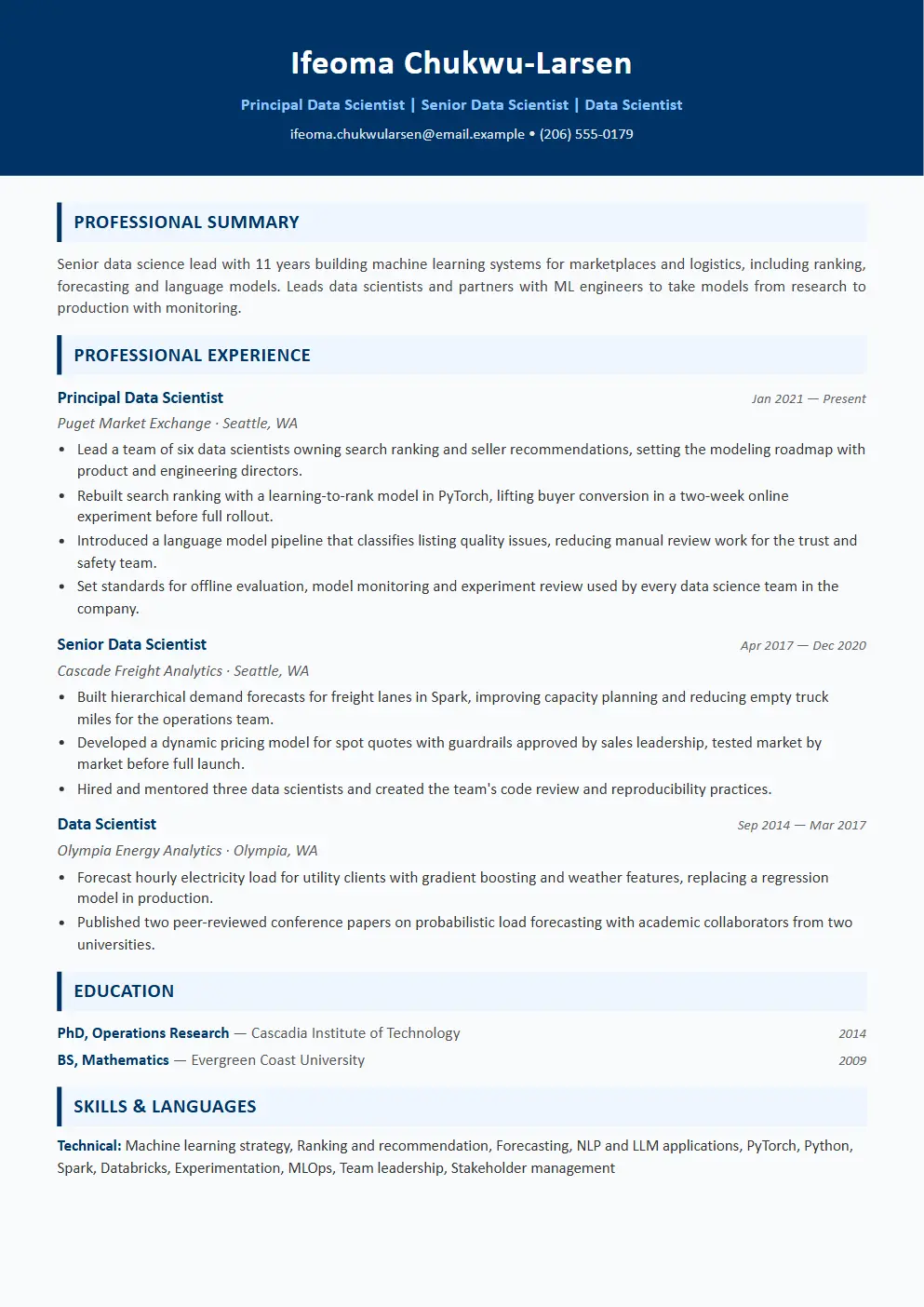
Ifeoma Chukwu-Larsen: Principal Data Scientist
Ifeoma's resume shows leadership through roadmaps, standards and production systems rather than notebooks. Her PhD and early publications support her credibility but stay brief; recent impact leads. The language model bullet is scoped to a real business use, and her ranking work states how it was validated before rollout, which senior hiring managers check first.
Read this resume as text
Ifeoma Chukwu-Larsen · Seattle, WA · ifeoma.chukwularsen@email.example · (206) 555-0179
Summary
Senior data science lead with 11 years building machine learning systems for marketplaces and logistics, including ranking, forecasting and language models. Leads data scientists and partners with ML engineers to take models from research to production with monitoring. Known for choosing the simplest model that solves the business problem and proving it with experiments.
Experience
Principal Data Scientist, Puget Market Exchange · Seattle, WA · Jan 2021 — Present
- Lead a team of six data scientists owning search ranking and seller recommendations, setting the modeling roadmap with product and engineering directors.
- Rebuilt search ranking with a learning-to-rank model in PyTorch, lifting buyer conversion in a two-week online experiment before full rollout.
- Introduced a language model pipeline that classifies listing quality issues, reducing manual review work for the trust and safety team.
- Set standards for offline evaluation, model monitoring and experiment review used by every data science team in the company.
Senior Data Scientist, Cascade Freight Analytics · Seattle, WA · Apr 2017 — Dec 2020
- Built hierarchical demand forecasts for freight lanes in Spark, improving capacity planning and reducing empty truck miles for the operations team.
- Developed a dynamic pricing model for spot quotes with guardrails approved by sales leadership, tested market by market before full launch.
- Hired and mentored three data scientists and created the team's code review and reproducibility practices.
Data Scientist, Olympia Energy Analytics · Olympia, WA · Sep 2014 — Mar 2017
- Forecast hourly electricity load for utility clients with gradient boosting and weather features, replacing a regression model in production.
- Published two peer-reviewed conference papers on probabilistic load forecasting with academic collaborators from two universities.
Education
PhD, Operations Research, Cascadia Institute of Technology (2014)
BS, Mathematics, Evergreen Coast University (2009)
Skills
Machine learning strategy, Ranking and recommendation, Forecasting, NLP and LLM applications, PyTorch, Python, Spark, Databricks, Experimentation, MLOps, Team leadership, Stakeholder management
Tailor this resume to a job in 30 seconds
Paste a real data scientist posting and AutoApplyMax rewrites your own resume for it: same facts, reordered and rephrased around what that employer asks for. The free plan includes 1 tailored resume a month.
How to write each section of a data scientist resume
Header and links
List name, city, email, phone, LinkedIn and a GitHub link if it contains your own well-documented work. A personal site with two or three project write-ups helps, especially for career changers and new graduates. Kaggle profiles are worth linking only when you placed well or wrote strong public notebooks.
Add a Google Scholar link if you have publications relevant to the role.
Summary
Say what kind of data scientist you are: product and experimentation, machine learning and production systems, forecasting, NLP, or research. The title covers very different jobs, and the first line should help a recruiter route you to the right one.
Include years of experience, industries and your strongest methods, then a short line on how your work reaches decisions or products.
Experience
Each bullet should connect a question, a method and a result. Results can be business metrics, decisions made, models deployed or hours saved for another team. Name the evaluation approach, such as a holdout test, backtest or online experiment, since hiring managers want to see that you validate work properly.
Avoid bullets that only list algorithms. A simple model that changed pricing beats a complex one that never left a notebook, and interviewers will ask you to defend every claim.
Skills
Group skills into programming and data tools, statistics and modeling methods, machine learning frameworks and platforms. Python and SQL are expected nearly everywhere; R matters in some research, health and insurance teams.
List cloud and production tools, such as Databricks, SageMaker, MLflow or Airflow, only if you have used them to deliver work. Avoid long lists of every library you have imported once.
Education, research and projects
Many data scientist roles prefer a master's or PhD in a quantitative field, so list degrees clearly with thesis topics when relevant. PhD holders moving into industry should translate research into business terms: data size, methods, collaborators and outcomes.
New graduates should add one or two projects with real data, a clear question and honest evaluation. Publications go in a short section after education.
Data Scientist resume summary examples
Entry-level objective: Statistics master's graduate seeking an entry-level data scientist role in forecasting or product analytics. Brings a retail demand forecasting internship that reached a store pilot, thesis research on churn models and clean, documented Python and SQL.
It names the target area and offers proof that work left the classroom and was used by a business.
New-grad summary: Data scientist with research and internship experience in forecasting, survival analysis and experiment design. Builds models in Python and R, writes SQL pipelines in Snowflake and presents results to business teams in Tableau. Focused on models that people actually use.
It sounds like an early-career professional, with methods, tools and audience all present.
Mid-level summary: Product data scientist with five years in subscription software and insurance. Designs experiments, applies causal inference when tests are not possible, and ships churn, pricing and triage models with engineering partners. Known for clear recommendations that product leaders act on.
It positions the candidate in a clear sub-field and emphasizes decisions and production, not only analysis.
Senior summary: Principal data scientist and team lead with 11 years building ranking, forecasting and language model systems for marketplaces and logistics. Sets modeling roadmaps, evaluation standards and monitoring, and proves value through online experiments. PhD in operations research.
Scope, domain, leadership and rigor are all visible, with the degree supporting rather than leading.
Data Scientist resume bullet examples: weak vs strong
The strong versions use made-up figures for a fictional candidate. Replace them with your own real numbers, or describe the scope (team size, volume, frequency) if you have none.
States the model, how it is used and how its value was proven, which is what interviewers probe.
Shows you improved how the whole company experiments, not only that you analyzed tests.
Includes scope, features, a fair baseline comparison and a real business follow-up.
Names a method suited to the constraint and shows judgment about when experiments are impossible.
Shows you understand what it takes to keep a model safe and maintained after launch.
Ties a trendy method to a concrete workflow and keeps a human in the loop, which shows sound judgment.
Maintainable work that others adopt shows engineering maturity many junior candidates lack.
Team size, ownership area and a concrete practice show leadership beyond project management.
Keywords from live data scientist job postings
We read 214 live data scientist postings (34 US and 180 Canadian) from our job feed on October 14, 2026 and counted how many mention each skill, tool or credential. A posting counts once per term, wherever it appears in the title or description. Use the list to check your resume for gaps that are real for you, not as a checklist.
| Keyword | Postings | |
|---|---|---|
| Machine learning | 166 of 214 (78%) | |
| Python | 158 of 214 (74%) | |
| Statistics | 144 of 214 (67%) | |
| SQL | 126 of 214 (59%) | |
| Stakeholders | 110 of 214 (51%) | |
| Data visualization | 80 of 214 (37%) | |
| Master's or PhD | 71 of 214 (33%) | |
| R | 69 of 214 (32%) | |
| Optimization | 67 of 214 (31%) | |
| LLMs / generative AI | 61 of 214 (29%) | |
| A/B testing | 56 of 214 (26%) | |
| AWS / SageMaker | 56 of 214 (26%) | |
| Time series forecasting | 54 of 214 (25%) | |
| Mathematics or statistics degree | 51 of 214 (24%) | |
| MLOps | 46 of 214 (21%) | |
| Spark | 45 of 214 (21%) | |
| Databricks | 39 of 214 (18%) | |
| PyTorch | 33 of 214 (15%) | |
| TensorFlow | 33 of 214 (15%) | |
| scikit-learn | 32 of 214 (15%) | |
| Feature engineering | 29 of 214 (14%) | |
| Causal inference | 27 of 214 (13%) |
Source: 214 unique postings whose title matches the role, from the WhatJobs publisher feed (US and Canada), collected October 14, 2026. Duplicate reposts were counted once. Counts change daily; a term not listed may still matter for a specific employer.
Skills for a data scientist resume
Programming and data
- Python
- SQL
- R
- pandas
- Spark
- dbt
- Git
Show SQL and Python depth through pipelines or production code, not only analysis notebooks.
Statistics and experimentation
- Hypothesis testing
- A/B test design
- Causal inference
- Bayesian methods
- Regression
- Time series
Product data science roles screen heavily on experiment design and causal reasoning.
Machine learning
- scikit-learn
- XGBoost and LightGBM
- PyTorch
- TensorFlow
- NLP and language models
- Recommendation and ranking
Name the problems you solved with each, along with how you evaluated them.
Platforms and MLOps
- Databricks
- Snowflake
- BigQuery
- SageMaker
- MLflow
- Airflow
- Docker
List the ones you used to ship or monitor models, which matters for ML-focused roles.
Soft skills, and how to prove them
- Problem framing: Describe a vague request you turned into a clear question, metric and analysis plan that stakeholders agreed on.
- Communicating uncertainty: Mention a recommendation where you explained confidence intervals or model limits to non-technical leaders and they still made a decision.
- Collaboration with engineers: Show a model you shipped with engineering, including the trade-offs you made for latency, maintenance or data availability.
- Skepticism: Give an example where you caught data leakage, a flawed metric or a misleading test result before it drove a decision.
- Mentoring: Name analysts or junior data scientists you coached and the methods or practices they adopted.
Certifications and licenses
- Google Cloud Professional Machine Learning Engineer (Google Cloud): Relevant when the role builds and deploys models on Google Cloud; less important for analysis-heavy roles.
- Microsoft Certified: Azure Data Scientist Associate (Microsoft): Covers training and deploying models with Azure Machine Learning; useful in Microsoft-centered companies.
- AWS Certified Machine Learning Engineer – Associate (Amazon Web Services): Focuses on building and operating ML workloads on AWS, including SageMaker.
- Databricks Certified Machine Learning Associate (Databricks): Shows practical skill on the Databricks platform, which many data teams use for large-scale modeling.
Looking for low-cost options? See our list of free certifications in this field.
US vs Canada: data scientist resumes and pay
United States
Data scientist is an unregulated title in the US, and its meaning varies by company from analytics to machine learning engineering, so match the posting's emphasis. Health, finance and insurance roles may ask about HIPAA, model risk management or fair lending rules. Government and defense work can require citizenship and a security clearance. Many postings ask for a master's or PhD, but strong experience often substitutes. Leave out photo, age and marital status, and answer sponsorship questions in the application, not on the resume.
| BLS occupation | 10th pct. | Median | 90th pct. |
|---|---|---|---|
| Data Scientists (SOC 15-2051) | $67,240 | $120,230 | $199,130 |
Annual wages, US national, BLS Occupational Employment and Wage Statistics, May 2025.
Canada
In Canada, data scientist is also unregulated, though data scientists should avoid calling themselves engineers without a license in provinces that enforce the title. Privacy rules differ: PIPEDA applies federally, Quebec's Law 25 adds stricter obligations including impact assessments for some transfers, and public sector work follows provincial laws. Mentioning experience with anonymization or privacy reviews helps. Research hubs in Toronto, Montréal and Edmonton value publications and graduate degrees. Quebec and federal roles may require French. Mention work permit status if relevant.
| Job Bank occupation | Low | Median | High |
|---|---|---|---|
| Data Scientist (NOC 21211) | $30.00/h | $46.15/h | $69.74/h |
Canada-wide wages in CAD, Job Bank (Government of Canada), reference period 2023-2024. Provincial figures differ; follow the link for your province.
Check your data scientist resume before you apply
The free ATS checker compares your resume with a real job description and lists the keywords you are missing. No signup needed for the scan.
FAQ
Do I need a PhD to become a data scientist?
No. Many data scientists have a master's or a bachelor's with strong experience. A PhD helps for research-heavy roles in machine learning, NLP or computer vision, and at some large tech companies. For product and analytics-focused data science, experimentation skills, SQL and business sense often matter more than the degree level.
How is a data scientist resume different from a data analyst resume?
A data scientist resume should show modeling, experimentation, statistical depth and often production work, not only reporting and dashboards. If you are moving from analyst to scientist, highlight predictive models, tests you designed and code that others maintain. Keep the dashboards that drove decisions but make modeling the headline.
Should I include Kaggle competitions?
Include them if you placed well or the competition matches the job, such as forecasting or NLP. Describe your approach and ranking briefly. Kaggle shows modeling skill but not problem framing or stakeholder work, so it should support real projects or experience, not replace them.
How do I show impact if my model was never deployed?
Describe the decision your analysis informed, the evaluation you ran and what you learned. If the model was not deployed, say why honestly in an interview, for example data access or business priorities. Show other evidence of production skill, such as clean pipelines or code adopted by others.
Should I list generative AI skills on my resume?
Yes, if you have built something real, such as a classification pipeline, retrieval system or evaluation process using language models. Describe the use case, how you measured quality and how you handled risks like errors or sensitive data. Listing tool names without a project adds little.