Free salary calculator: pay ranges and salary to hourly
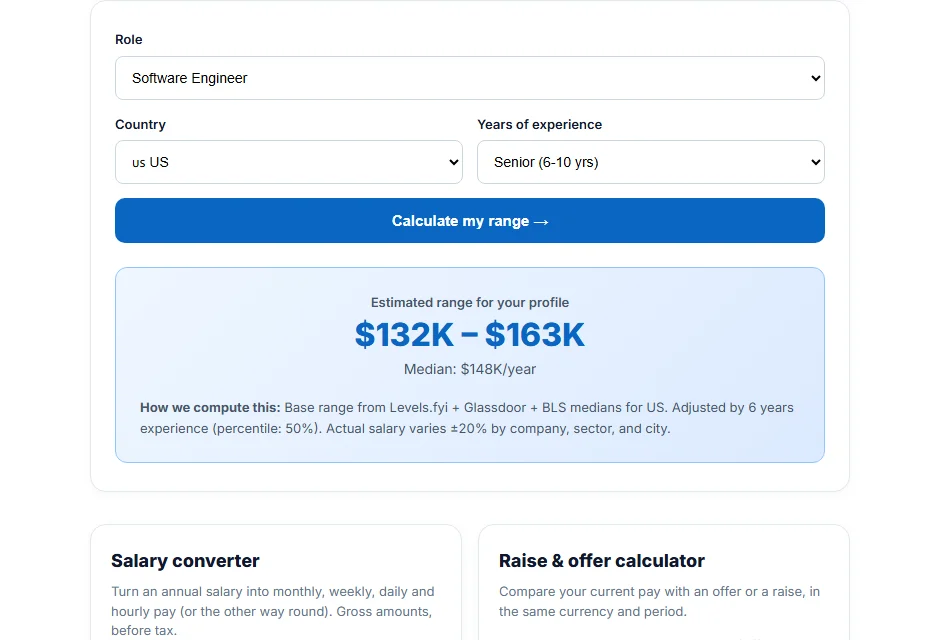
Estimate a salary range by role, country and years of experience, based on public salary data from Levels.fyi, Glassdoor and the BLS. Free, no signup.
Updated
Estimated range for your profile
What you get
An estimated salary range and median for your role, country and years of experience.
A converter from annual salary to monthly, weekly, daily and hourly pay, and back.
A raise and offer calculator that compares your current pay with a new one in the same currency and period.
Use the range when you answer the salary question in an application, then find openings on the jobs page and log every application in the job application tracker. Before you apply, check your resume against the posting with the ATS score checker, and see the job search guides for negotiating an offer.
What the salary calculator factors in
Ranges are built from public salary data (Levels.fyi, Glassdoor, BLS) and kept deliberately simple: a quick sanity check before you apply or negotiate.
9 countries
US, UK, France, India, Germany, Canada, Australia, Spain and the Netherlands, each in local currency (USD, GBP, EUR, INR, CAD, AUD) with no forced conversion.
Experience curve
The range moves up the band as your experience grows: entry-level sits near the bottom, senior around the middle to upper part, and lead roles near the top.
9 role families
Software Engineer, Product Manager, Data Scientist, UX/UI Designer, Marketing Manager, Sales/AE, Finance Analyst, HR Manager, Operations Manager: nine of the most common white-collar roles.
A range, not just a number
You get a low–high band with the median highlighted. Real offers vary with company size, industry and city, so treat it as a starting point.
Example results
Three example results from the calculator, shown with sample profiles.
Product Manager · Paris
Sophie Dubois
6 years experience · SaaS product
Estimated range
€68K – €85K
Median: €77K/year · 65th percentile
Interpretation
An offer below €68K is on the low side for her level; larger tech companies in Paris often pay above this range.
Software Engineer · London
James Whitfield
5 years experience · Backend, Go/Kafka
Estimated range
£70K – £92K
Median: £81K/year · 55th percentile
Interpretation
Fintech and trading firms in London can pay well above this range, especially once bonus and equity are included. Compare total compensation before signing.
Data Scientist · Bengaluru
Ananya Krishnan
4 years experience · ML/analytics
Estimated range
₹22 – 38 LPA
Median: ₹30 LPA/year · 45th percentile
Interpretation
Big tech offices in India often pay above this range at this level, while early-stage startups may pay below it. The gap is large, so know your target.
Frequently asked questions
Where does the salary data come from?
The ranges come from a simplified table built from public salary data: Levels.fyi, Glassdoor salary reports and government wage statistics such as the US BLS. They show base salary in local currency, not total compensation with equity or bonus, and are meant as a rough sanity check rather than a precise quote.
Is this calculator free?
Yes. Unlimited free use, no signup and no email. The calculation runs in your browser.
Why is my offer below the median?
Company stage, industry and city all move pay. Early-stage startups often pay less in cash and make up for it with equity, large tech companies often pay well above typical ranges, and many non-tech industries pay below them. Use the range as a starting point, then adjust for the company in front of you.
How should I use this range in a negotiation?
Check where the offer sits in the range before you reply. If it's near the bottom and your experience is solid, it's reasonable to ask for a number closer to the top of the range and back it up with your results.
Why check your salary before applying?
Many people accept offers below the market rate for their role, city and experience. Common reasons:
Anchoring — you aim for a small raise on your current salary instead of the market rate
Outdated benchmarks — your idea of a good salary dates from your last job search
Company pay bands — large tech companies and early-stage startups can pay very differently for the same role
City differences — the same role usually pays more in San Francisco than in Chicago, or in Paris than in Lyon
To turn an annual salary into an hourly rate, divide it by the number of hours you are paid for in a year:
hourly rate = annual salary ÷ (hours per week × paid weeks per year)
Full time in the US is usually counted as 40 hours × 52 weeks = 2,080 hours a year. At 37.5 hours a week, a schedule many salaried contracts in Canada and elsewhere use, it is 1,950 hours.
The salary converter at the top of this page does exactly this sum. Change “Hours per week” and “Paid weeks per year” to match your contract and it recalculates yearly, monthly, weekly, daily and hourly pay. All amounts are gross (before tax).
Annual salary
Hourly at 40 h/week (2,080 h)
Hourly at 37.5 h/week (1,950 h)
Monthly (÷ 12)
$40,000
$19.23
$20.51
$3,333
$50,000
$24.04
$25.64
$4,167
$60,000
$28.85
$30.77
$5,000
$75,000
$36.06
$38.46
$6,250
$100,000
$48.08
$51.28
$8,333
The same maths works in any currency: C$60,000 at 37.5 hours a week is C$30.77 an hour. The reverse is a multiplication: hourly × 2,080 gives the annual figure for a 40-hour week, so $20 an hour is $41,600 a year, $25 is $52,000 and $30 is $62,400. A quick mental shortcut is “double the hourly rate and add three zeros” ($25 → about $50,000), which slightly understates the exact figure.
Unpaid time changes the answer
If you are an hourly contractor with no paid vacation, you are only paid for the weeks you work. Someone billing $50 an hour who takes four unpaid weeks off works 48 weeks: 40 × 48 × $50 = $96,000, not $104,000. Set “Paid weeks per year” to 48 in the converter to see this. When you compare a contract rate with a salaried offer, also price in the benefits a salaried job usually includes, such as paid time off and employer health or pension contributions.
Weekly, biweekly, semi-monthly or monthly: what each paycheck looks like
The same salary produces different paycheck amounts depending on how often you are paid. Biweekly and semi-monthly sound alike but are not the same:
Pay frequency
Paychecks per year
Gross per paycheck on $60,000
Weekly
52
$1,153.85
Biweekly (every two weeks)
26
$2,307.69
Semi-monthly (twice a month, e.g. 15th and last day)
24
$2,500.00
Monthly
12
$5,000.00
With biweekly pay, two months a year contain a third paycheck, which is why a biweekly budget built on “two paychecks a month” leaves a little extra twice a year. When an offer letter quotes pay per period, multiply back to an annual figure before you compare it with another offer.
Overtime: US and Ontario rules
Hourly rates matter most when overtime is involved. In the US, the Fair Labor Standards Act requires covered employees to receive overtime for hours worked over 40 in a workweek at no less than time and one-half their regular rate (US Department of Labor: overtime pay). Some salaried employees are exempt, so check whether your role is classified as exempt or non-exempt before you count on overtime. Several states add their own rules on top.
In Canada, overtime is set province by province. In Ontario it starts after 44 hours in a work week, at 1½ times the regular rate (Ontario: Your guide to the Employment Standards Act, overtime pay). Other provinces use different thresholds, so check your province’s employment standards page.
Worked example: $25/hour, 45 hours in one week
US (FLSA, non-exempt): 40 × $25 + 5 × $37.50 = $1,187.50
Ontario: 44 × $25 + 1 × $37.50 = $1,137.50
Gross pay vs take-home pay
Every figure on this page is gross: what you earn before deductions. The calculators here do not estimate tax, because tax depends on your state or province, filing status, benefits and retirement contributions. Your take-home (net) pay is lower once your employer withholds:
US: federal income tax, state and sometimes local income tax, Social Security and Medicare, plus any pre-tax deductions such as a 401(k) or health insurance premiums.
Canada: federal and provincial or territorial income tax, Canada Pension Plan (CPP) contributions and Employment Insurance (EI) premiums.
For a real take-home figure, use the official tools:
IRS Tax Withholding Estimator — works out how much federal income tax should be withheld from each paycheck and produces a pre-filled Form W-4. The IRS says it takes about 25 minutes and you’ll need recent pay stubs.
CRA Payroll Deductions Online Calculator — calculates federal, provincial (except Quebec) and territorial deductions, including CPP and EI. Quebec residents use Revenu Québec’s WebRAS for provincial deductions.
Where to research the going rate for your job
The ranges in the calculator above are a quick sanity check across nine roles. For any other job, or for your exact city, go to the public sources:
US — Occupational Outlook Handbook (BLS): median pay, typical education and job outlook for hundreds of occupations.
US — Occupational Employment and Wage Statistics (BLS): wage estimates for about 830 occupations, nationally, by state and by metropolitan area. Use it when city pay matters, for example comparing the same role in Austin and New York.
Canada — Job Bank wage search: compare what an occupation pays in different parts of the country, by job title and location.
The job postings themselves. More US postings now show a pay range because of state pay transparency laws. In California, employers with 15 or more employees must include the pay scale in any job posting, and generally cannot ask about your salary history (California Labor Commissioner). Washington requires employers with 15 or more employees to include a wage scale or salary range and a description of benefits (Washington L&I). New York requires employers with four or more employees to list compensation ranges for advertised jobs (New York State Department of Labor).
Collect five to ten postings for the same title and level in your area, note each range, and you have a market band specific to your search. The job feed and application tracker make it easy to keep the ranges you find next to each application.
How to answer “desired salary” on a job application
Many online application forms ask for an expected or desired salary, sometimes as a required field. A few rules that keep you from under-pricing yourself:
Use the posted range if there is one. Aim for the middle to upper part of it if your experience matches the requirements.
Give a range, not a single number, when the field allows text: “$78,000–$88,000 base, depending on the full package.” Put the bottom of your range at a figure you would genuinely accept.
If the field only takes a number, enter your researched market figure for the role and city, not your current salary plus a few percent.
Talk about base salary separately from bonus, equity and benefits. A lower base can be fine if the rest of the package makes up for it — but only if you’ve priced the rest.
Be consistent. Use the same range across the form, the recruiter screen and the interview.
AutoApplyMax’s extension fills the fields of application forms from your profile when you apply on LinkedIn Easy Apply (auto-apply) or on other job sites and ATS portals (autofill, where you review and click Submit yourself). Set your expected salary once in your profile so the same figure goes into every form; read more about AI autofill.
A short salary negotiation script
Once you have an offer, reply in writing, thank them, and anchor on your research. A template you can adapt:
“Thank you for the offer — I’m excited about the role and the team. Based on my research for [job title] roles in [city] at my level, and on [one concrete result, e.g. ‘leading the migration that cut hosting costs by a third’], I was expecting a base salary closer to [$X]. Is there flexibility to get there? If base salary is fixed, I’d be glad to discuss [signing bonus / extra vacation / an earlier salary review].”
Use the raise & offer calculator to see exactly what the gap is worth per year and per month before you send it. Keep the tone collaborative, name one number (not a range) at this stage, and stop writing once you’ve asked. More tactics in our salary negotiation tips; and if you are still job hunting, make sure each application is strong with the free ATS score checker and AI resume builder.
Salary to hourly: more questions
How do I convert my salary to an hourly rate?
Divide your annual salary by the hours you are paid for in a year. For a 40-hour week with 52 paid weeks that is 2,080 hours, so $60,000 a year is $28.85 an hour. The converter on this page does it for any hours and weeks.
How much is $25 an hour per year?
$52,000 a year before tax at 40 hours a week for 52 weeks ($25 × 2,080). At 37.5 hours a week it is $48,750.
How do I convert salary to hourly in Canada?
Use the same formula with your contracted hours. If your contract says 37.5 hours a week (1,950 hours a year), so C$65,000 is C$33.33 an hour; at 40 hours it is C$31.25. Enter your hours in the converter to get the exact figure.
Does this calculator show take-home pay after tax?
No. All results are gross pay before tax. For take-home pay, use the IRS Tax Withholding Estimator in the US or the CRA Payroll Deductions Online Calculator in Canada.
What is the difference between biweekly and semi-monthly pay?
Biweekly means every two weeks, 26 paychecks a year. Semi-monthly means twice a month on set dates, 24 paychecks a year. On a $60,000 salary that is $2,307.69 versus $2,500 gross per paycheck.
How is overtime calculated?
In the US, non-exempt employees covered by the FLSA earn at least 1.5 times their regular rate for hours over 40 in a workweek. In Ontario, overtime starts after 44 hours a week at 1.5 times the regular rate. Other provinces and some states have their own rules.
💰 Spend your time on jobs worth applying to
Free AutoApplyMax account:
✓Personalized job picks matched to your profile
✓Auto-apply on LinkedIn Easy Apply + autofill on 100+ ATS portals
✓AI-tailored resume per job (1 free AI credit a month)
✓Application tracker with statuses from applied to offer