Writing a cover letter with no work experience feels impossible when every template you find online opens with "During my 5 years at [Company X]…" It isn't. In 2026, a good no-experience cover letter reads exactly like an experienced one — because projects, coursework, volunteer work, side hustles, and self-directed learning are all valid "experience", provided you frame the result and the impact, not just the activity.
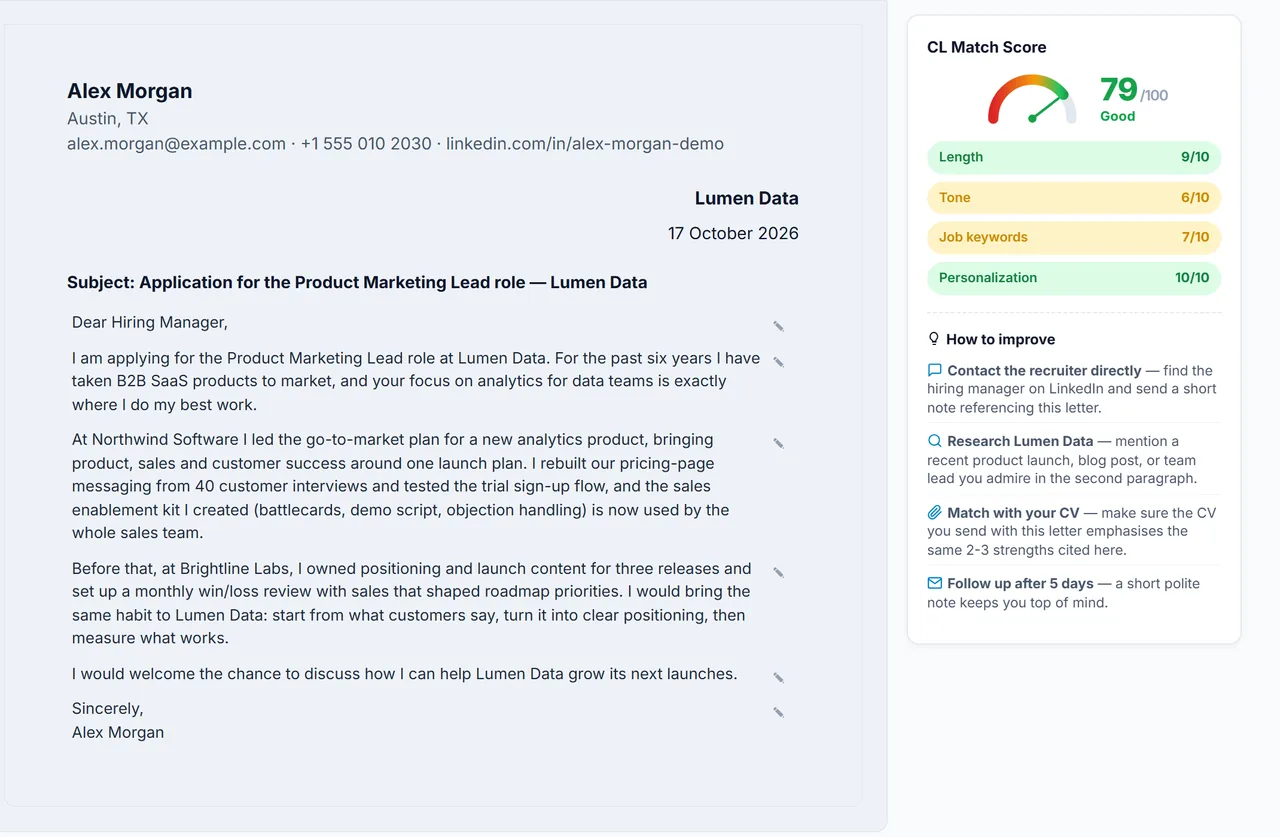
Below is the proven three-paragraph template hiring managers actually respond to, three complete examples (student, career-switcher, no-degree candidate), and the five do/don't rules that separate cover letters that get interviews from cover letters that get ignored.
Why cover letters still matter in 2026 (yes, even with AI)
Roughly 60% of hiring managers say they still read cover letters for entry-level roles — because 90% of resumes look identical for entry-level candidates. The cover letter is the one place you get to say "here's why I'm different from the 400 other applicants." Skip it, and you compete on GPA and school name alone. Write a good one, and your reply rate goes up 15-30%.
The catch: with AI cover-letter generators everywhere in 2026, generic AI output is now easier to spot than ever. Hiring managers can smell "As a recent graduate of [University], I am writing to express my strong interest in the [Position] role" from a mile away. The winning approach is: use AI to draft fast, then edit hard for specificity and voice.
The 3-paragraph template that works
Every successful no-experience cover letter follows the same architecture. Copy this shape, fill in your specifics:
Paragraph 1 — Hook (2-3 sentences). Name the job. Name one specific thing about the company (a recent launch, a value in the JD, a stat). Say what you'd bring in one sentence.
Paragraph 2 — Proof (4-6 sentences). ONE concrete example of a project / course / volunteer / side-hustle result, framed as evidence you can do this job. Include a number.
Paragraph 3 — Close (2-3 sentences). Why THIS specific company (not "a great place to grow"). One clear ask: an interview, a call, a portfolio review.
Total length: 250-320 words. Three paragraphs. One page. Anything longer signals you can't edit.
Example 1: Student applying for a marketing internship
Dear Ms. Chen,
I'm applying for the Marketing Intern role at Notion, referenced on your careers page. Your recent AI Blocks launch is the closest thing I've seen to solving the "which tool does X" problem in productivity — I've been evangelising it to my student org since June.
Over the last academic year I ran the Instagram account for our university's business club (2,400 followers). I redesigned the content mix from event announcements to case-study threads — the kind of practical breakdowns Notion does so well — and grew engagement 3.4× (from 1.1% to 3.8%) over 90 days. Two of those posts drove 40+ signups to our workshop series, our best-ever result. I've also written five long-form Notion tutorials on Medium, one of which was picked up by the r/Notion subreddit and got 12,000 views.
I'd love a 20-minute call with your marketing team to walk through the content playbook I ran and share a mock content calendar I've built for Notion's back-to-school moment. My portfolio is at [your-portfolio.com]. Thank you for your consideration.
Best regards,
Alex Rivera
Why it works: Names the exact role. Names a specific product launch (not "Notion is amazing"). Uses one strong result (3.4× engagement, 40 signups). Ends with a concrete ask (20-minute call + specific mock deliverable).
Example 2: Career-switcher (teacher → tech project manager)
Dear Hiring Team,
I'm applying for the Associate Product Manager role at Stripe. I've spent six years teaching high-school math to 180 students a semester — which turns out to be excellent training for the "translate complex systems into 90-second explanations" part of a PM's job. Your Radar 4.0 announcement made me want to switch industries.
In year 4 of teaching I ran a district pilot to replace paper grade reports with a Google Apps Script dashboard I built (self-taught over the summer). Rolled it out to 12 teachers, cut grade-report prep time from 4 hours/week to 20 minutes, and got a full district-wide adoption vote in May 2025 — 340 teachers now use it. I ran the requirements-gathering sessions, wrote the change docs, and handled the "why the buttons moved" support tickets myself. That's the muscle I want to bring to Stripe: hearing an unclear user need, shipping a small tool, iterating fast.
Stripe is at the top of my list because your engineering team's memos are the reason I understand REST APIs at all — I taught myself using your docs. I'd love a call to share the two Stripe-specific product ideas I've been sketching for the last month. Portfolio at [your-portfolio.com].
Sincerely,
Jordan Patel
Why it works: Owns the career switch instead of hiding it — "translate complex systems" reframes teaching as PM training. One concrete story (340-teacher adoption), one number. Names a specific Stripe product (Radar 4.0) and cites their engineering docs as the credibility hook.
Example 3: No-degree candidate for a junior developer role
Dear Ms. Ahmed,
I'm applying for the Junior Frontend Developer role at Linear. I don't have a CS degree — but I do have two shipped side projects, 40 hours of Linear API code, and a working knowledge of your keyboard-first design principles from six months of daily use.
Six months ago I built a habit-tracker web app (React + Supabase + Tailwind) to solve my own accountability problem. I open-sourced it in March; it has 480 GitHub stars, 22 external contributors, and 3,100 monthly active users. Every user-reported bug becomes a PR the same night — my closed-issue rate is 87%. I also built a Linear browser extension in August that batch-updates issue labels from a keyboard shortcut; it's not published yet but I'd be happy to walk your team through the code.
Linear is the software I open first every morning. I've read every Linear engineering blog post and want to work on a team that treats performance as a design constraint. Could we set up a 30-minute call so I can walk through the code and hear about your onboarding path for developers without formal degrees? GitHub: [github.com/username].
Regards,
Sam Wong
Why it works: Addresses the "no degree" gap head-on in sentence one. Frames it as offset by shipped work. Gives real numbers (480 stars, 22 contributors, 87% closed-issue rate). Names specific Linear-flavoured admiration (engineering blog, performance-as-design-constraint).
5 do's and 5 don'ts that decide the outcome
Do
- Do open with the specific role name and one company-specific hook. Not "your innovative company." Recent launch, quoted values, a stat from their blog.
- Do include one number, minimum. Any number: engagement percentage, GitHub stars, students taught, hours saved, dollars raised. Numbers convert "I did X" into evidence.
- Do reframe "no experience" as a specific transferable skill. Teaching = translating complex systems. Retail = handling angry customers under pressure. Sports = performing under a time constraint with a team. Never apologise for the gap; reframe it.
- Do end with a specific ask. "20-minute call to walk through my portfolio" beats "I look forward to hearing from you."
- Do write to a person if you can find one. Two minutes on LinkedIn to find the hiring manager's name is worth it. "Dear Ms. Chen" outperforms "Dear Hiring Team" by ~20%.
Don't
- Don't summarise your resume. The recruiter has the resume open next to your cover letter. Say ONE new thing that isn't on the resume.
- Don't apologise for being new / inexperienced / young. "Although I don't have direct experience…" is the #1 red flag. Delete every "although" and "despite."
- Don't use AI without editing hard for voice. Every generic AI opener ("I am writing to express my strong interest") has been read 400 times this week. Sound like a person.
- Don't exceed one page. Any letter that scrolls past 320 words gets skimmed. Cut ruthlessly.
- Don't send the same letter to five different companies. If you can copy-paste it, the recruiter can tell. Change at least the hook + the "why this company" close for every application.
The "no experience but strong project" playbook
If you truly have zero paid work experience, spend one weekend building "the project" — the single accomplishment your cover letters will lean on for the next 6 months. Real examples that work in 2026:
- For marketing roles: Grow a small Instagram / TikTok / LinkedIn to 1,000+ followers documenting your learning of the industry. That's your case study.
- For product/PM roles: Write a public product-critique post for the target company's app. Post on LinkedIn. Include mockups.
- For dev roles: Build one small open-source tool that solves a real problem you personally have. Ship it, get 20+ users, iterate publicly.
- For sales/BD: Cold email 20 startups pitching yourself as a free intern for 2 weeks. The 3 who say yes become your cover letter proof.
- For customer support: Volunteer as an admin in a busy Discord or subreddit. The moderator role = "handled 200 disputes/month" on your resume.
One good project is worth more than three internships that were mostly Excel busywork. Spend the weekend building it before you write the letter.
Do you need a cover letter for every application?
Rules of thumb for 2026:
- Always write one if: the job posting says "cover letter required," the role is competitive (marketing, product, consulting, design), you're changing industry, or you're applying to a company with fewer than 100 employees (personal touch matters more there).
- Skip if: the ATS portal has no upload field, or the role is high-volume hourly (retail, warehousing, call-centre — recruiters don't read them at scale).
- Middle ground for LinkedIn Easy Apply: paste 3-4 sentences (a mini cover letter) in the "additional information" field. It doubles reply rate vs. a blank field. Yes, even for auto-apply — see below.
Auto-generate a cover letter per role in seconds
Writing three completely different cover letters per week (one per real opportunity) is realistic. Writing 30 is not — and applying to fewer than 30 roles per week kills your pipeline. That's the paradox every job-seeker hits.
Our free AI Cover Letter Generator is built for this: paste the job description + your profile, and it drafts a cover letter using this exact three-paragraph template. You edit for voice in 30 seconds instead of writing from scratch in 15 minutes. Combined with LinkedIn auto-apply and AI Autofill on 100+ ATS portals, you can maintain both quality and volume for the first time.
For competitive roles where the letter is decisive, still hand-write. For the 25 out of 30 applications where you just need a solid non-generic letter fast, use the generator.
Generate a tailored cover letter for every role — in 15 seconds
AutoApplyMax's AI Cover Letter Generator produces a fresh, role-specific cover letter every time. 1 free credit on signup.
Sign up freeFrequently Asked Questions
How long should a cover letter with no experience be?
250-320 words, three paragraphs, one page. Longer signals you can't edit.
Should I mention that I have no work experience?
Only if the specific concern (no degree, career change, gap) is visible from the resume. In that case, address it head-on in one sentence, then move to your proof. Never lead with the negative.
Can I use ChatGPT to write my cover letter?
To draft: yes, absolutely. To send unedited: never. Recruiters can spot generic AI output instantly in 2026. Use AI for the skeleton, then rewrite the opening hook + the "why this company" close in your own voice.
What's the biggest mistake in no-experience cover letters?
Summarising your resume. The recruiter is already looking at your resume. Say something new in the cover letter — a project, a story, a specific reason for wanting this company.