Salary negotiation is the single highest-leverage 60-minute investment of your career. A well-anchored counter-offer can add $8,000 to $25,000 to your base for the same job you were about to accept — and it compounds every year you stay. Yet most candidates take the first number, or negotiate with feelings instead of data.
This guide skips the pep talks. Below are the 12 salary negotiation tools that actually give you leverage in 2026 — the databases recruiters check, the community sources that unmask internal pay bands, the calculators you need before you counter, and the exact word-for-word scripts that convert your data into a bigger paycheck. Every recommendation includes cost, use case, and the concrete outcome you should expect.
Quick comparison: the 12 tools ranked by leverage
| Tool | Best for | Cost | Leverage |
|---|---|---|---|
| Levels.fyi | Tech / product / eng | Free | ★★★★★ |
| Payscale | All industries | Free basic | ★★★★ |
| Blind (Teamblind) | Tech insider intel | Free (work email verify) | ★★★★★ |
| Glassdoor Salaries | Non-tech, general | Free | ★★★ |
| AutoApplyMax Salary Calculator | Quick role check pre-apply | Free | ★★★ |
| LinkedIn Salary Insights | Location-based ranges | Free w/ Premium trial | ★★★ |
| Bureau of Labor Statistics OEWS | US metro/role authority | Free | ★★★★ |
| Salary.com | HR-side benchmarks | Free basic | ★★★ |
| H1B Salary Database | Verified US tech salaries | Free (h1bdata.info) | ★★★★ |
| Fishbowl | Consulting / finance | Free | ★★★ |
| Comparably | Culture + salary combined | Free | ★★ |
| NYC / CA / CO Pay Transparency laws | Legal-mandated ranges on jobs | Free (read the JD) | ★★★★★ |
1. Levels.fyi — the gold standard for tech salaries
If you're negotiating a tech, product, or engineering role at any company with more than 200 employees, Levels.fyi is your starting point. Every entry is verified against a pay stub or offer letter (they check the screenshots), which means the data is the closest thing to ground truth you'll find on the internet. You can filter by company, level, location, and years of experience — and you get the exact base / bonus / equity breakdown, not just a total.
How to use it in a negotiation: Find your target company and level. Look at the 75th percentile (the top-25% offer for people at your level). That's your counter-offer anchor. Recruiters can't argue with data from their own company's employees.
Concrete example (2026): If Levels.fyi says the Meta E4 median TC is $312k and 75th percentile is $355k, and your offer came in at $280k, you counter at $345k with the sentence "based on the 75th percentile for E4 on Levels.fyi." You should expect $310-325k final.
Running several interview processes at once? Log each stage in the free job application tracker so no follow-up slips through.
2. Payscale — the general-purpose benchmark
For any non-tech role (marketing, sales, HR, ops, finance, healthcare, education), Payscale is more useful than Levels.fyi because it covers 1000+ roles and adjusts for city, years of experience, education, and skills. The free "personalized salary report" takes 5 minutes and gives you a 25th/50th/75th percentile range for your exact profile.
Signal quality: Self-reported, so the numbers skew slightly low (people over-report their titles, under-report their comp). Trust the 50th percentile as your realistic anchor and the 75th as your stretch counter.
3. Blind (Teamblind) — the insider community
Blind is an anonymous community where verified employees at 5000+ companies share the raw truth: exact offer numbers, refresher grants, negotiation outcomes, and manager reputations. Post your offer letter (anonymized) in the "Salary Negotiation" topic and you'll get 10-30 responses from people at the same company who negotiated last quarter.
Signup: Verify your current work email; you get a screen name that hides your identity. Warning: the tone can be brutal — that's the price of anonymous honesty.
4. Glassdoor Salaries — best for older/non-tech firms
Glassdoor's salary database is bigger than Levels.fyi outside of tech. If you're negotiating with a Big 4 accounting firm, a hospital system, a Fortune 500 industrial, or a regional bank, Glassdoor probably has data even when Levels.fyi doesn't. Combine it with Payscale for triangulation.
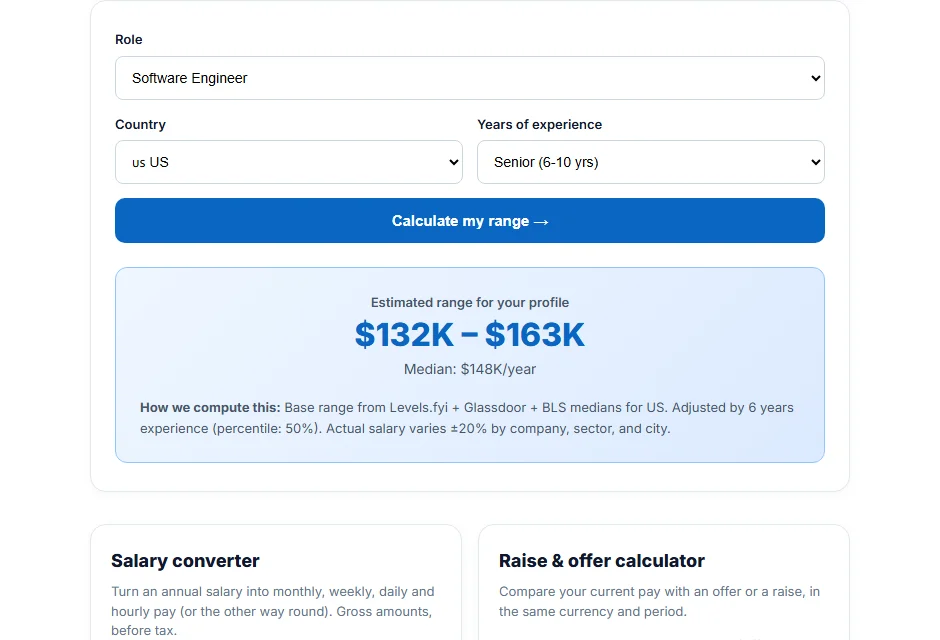
5. AutoApplyMax Salary Calculator — 30-second pre-application check
Before you even apply, our free Salary Calculator gives you a real 2026 range for your target role, location, and years of experience. It's built for the "should I even apply?" and "what should I put in the expected-salary field?" moments — not for a final counter-offer, but for making sure you don't apply at 40% below market by accident.
6. LinkedIn Salary Insights — location + role snapshots
LinkedIn shows an aggregated salary range for most job postings if you have Premium (30-day free trial is enough). It pulls from real user-submitted profiles + posted job comp bands, giving you a defensible number when you say "based on LinkedIn's data for [role] in [city]."
7. Bureau of Labor Statistics OEWS — the authority you cite last
The US Bureau of Labor Statistics Occupational Employment and Wage Statistics is the government's official salary dataset — updated annually, broken down by metro area and occupation code (SOC). It's the most legally-defensible number if you're negotiating with a large employer's HR / compensation team, because they use the same dataset internally.
8. Salary.com — the number HR sees
Salary.com licenses its comp bands to enterprise HR teams, which means when a compensation analyst at your target company runs "what does a Senior PM in Austin earn?" they're reading Salary.com. Get the same number they see before you negotiate.
9. H1BData.info — verified tech salaries (US)
US H-1B visa filings require employers to disclose the exact base salary for every foreign hire — that data is public. H1BData.info lets you search by company + role + year + city. It's a hard cross-check for Levels.fyi numbers and, for companies that don't post on Levels, often the only verified data source.
10. Fishbowl — consulting, finance, legal
If your industry is consulting (MBB), Big 4, investment banking, or law, Fishbowl is where verified professionals share bonus multiplier data, promotion timelines, and offer package details. Especially useful for post-MBA and lateral moves.
11. Comparably — culture + salary combined
Comparably ranks companies on culture, salary, and diversity. Its salary data is less deep than Payscale's, but the combined view is useful if you're comparing two offers and comp is close.
12. NYC / CA / CO / WA Pay Transparency laws — free data hiding in the JD
Since 2023, any job posted in NYC, California, Colorado, Washington State, or Illinois is legally required to include the salary range. If you're applying to a role posted in any of these states, the range is already in the job description. Screenshot it. When the recruiter later says "our band starts at $X," you have their own posted range as evidence for a counter.
Pro tip: Even if you live elsewhere, filter your job search to include one of these states for the same role. The posted range gives you cross-state comp data for free.
The 3 negotiation scripts that convert data into money
Data without a script is worthless. Below are the three word-for-word templates that convert Levels.fyi numbers into a bigger paycheck. Copy-paste, edit the placeholders, send.
Script 1: The email counter-offer (base salary)
Hi [Recruiter],
Thank you so much for the offer — I'm genuinely excited about the role and about joining [Team] to work on [specific project mentioned].
I've done some research on Levels.fyi and Payscale for [Role Title] at [Company] with my level of experience ([X] years in [specialty]), and the 75th percentile lands at approximately $[MARKET_75TH]. Given my track record — [1 concrete achievement with a number] — I was hoping we could align the base closer to $[YOUR_COUNTER, which is 10-15% above offer].
Is there flexibility to bring the base to $[YOUR_COUNTER]? I'd be ready to sign the same day.
Best,
[Your Name]
Script 2: The verbal push on the phone (soft close)
"I really appreciate the offer. Before I sign, based on the market data I've pulled for this role — Levels.fyi shows the 75th percentile at $X — is there room to bring the base to $Y? If we can get there I'm ready to commit today."
Why it works: You anchor on a public dataset (not personal need), name the number, and offer to close immediately. Recruiters are paid to close — a same-day yes is often more valuable to them than the $10k delta.
Script 3: The multi-lever counter (base + equity + sign-on)
"Thanks for the offer. I've broken the package into three levers I'd like to discuss:
1. Base: I was hoping for $[BASE + 10%] based on Levels.fyi 75th.
2. Sign-on: I'm walking away from $[X] in unvested equity — a $[SIGN_ON] sign-on would offset that.
3. Equity refresh: Is there a first-year refresh grant available if I hit ramp?
Even if base can't move fully, I'm flexible on the mix. What's possible on your end?"
Why it works: Recruiters have hard caps on base but often flexible sign-on and equity refresh budgets. By naming three levers you make it easy for them to say yes on the cheaper one instead of no on the whole package.
Common mistakes that leave money on the table
- Naming a number first. Never disclose "expected salary" until you have an offer. Say "I'd like to understand the role better first — what's the range you have budgeted?" The first number sets the anchor for the whole negotiation.
- Counter-offering with a single number. Always give a range with your target at the low end. "$115k-$125k" beats "$120k" because it lets them meet you in the middle at $120k feeling like they got a discount.
- Negotiating from personal need. "I have student loans and my rent went up" is not leverage. "Levels.fyi shows the 75th percentile is $X" is leverage. Never mix the two.
- Skipping equity + benefits. A $200k base with a $80k signing bonus + refresher schedule beats a $220k base with nothing else. Look at the 4-year total, not just year-1 base.
- Not getting it in writing. Every verbal agreement needs an updated offer letter before you sign. "Congratulations, we bumped you to $X" over the phone is worthless if it doesn't hit the PDF.
How much can you realistically expect to gain?
Based on aggregate Blind + Reddit data across 2024-2026 for negotiators who used the scripts above with real market data:
- Entry-level roles (0-3 years): $3,000 - $8,000 base bump. Sign-on rarely available.
- Mid-level (3-8 years): $8,000 - $18,000 base + $5-15k sign-on possible.
- Senior (8+ years): $15,000 - $40,000 base + $20-50k sign-on + refresher equity.
- Big Tech / FAANG: The variance widens. Levels.fyi shows successful negotiations moving TC by $30-90k at L5-L6 levels.
Even at the low end — $3k on an entry-level role — that's 60 hours of your future salary earned in 60 minutes of negotiation. Compounded over a career, negotiators out-earn non-negotiators by $500k-$1M lifetime.
How AutoApplyMax fits into your salary strategy
The biggest lever in salary negotiation isn't the counter-offer — it's having a competing offer. Recruiters bend on comp when they know you have alternatives. That means you need to be applying to 5-10 companies in parallel, not just the one you like most.
That's exactly why we built auto-apply on LinkedIn and universal AI autofill on 100+ ATS portals: to make the parallel job hunt trivially fast, so you always have 2-3 active pipelines when the counter conversation happens. Add a tailored AI cover letter for each so your response rate stays high, and you'll have the leverage most candidates never build.
Get multiple offers to negotiate from — apply faster
AutoApplyMax auto-applies on LinkedIn Easy Apply and universally autofills 100+ ATS portals so you can run 5+ pipelines in parallel. Free Chrome extension.
Sign up free