TL;DR -- Wait 5-7 business days, keep the email under 120 words, put the job title in the subject line, and end with a soft question rather than a wall of text. Six copy-paste templates below cover every real scenario -- standard follow-up, referral-based, recruiter ghost, post-recruiter-call, "still open?", and the polite final email.
Most applicants send zero follow-ups. That's the good news: sending a well-crafted email puts you in the top 20% of candidates before anyone has read a word of your resume. The bad news is that most follow-ups get deleted in 3 seconds because they're generic, too long, or don't tell the recruiter what to do next.
This guide gives you six templates for the real scenarios that come up in a 2026 job search, plus the timing rules that decide whether your email gets a reply or a swipe.
The 3 Rules Every Follow-Up Must Follow
- Job title in the subject line. Recruiters manage 15-40 open roles at once. Without the title, your email is context-free.
- Under 120 words. If you can't say it in 3-5 sentences, you're pitching, not following up.
- Ask a small, answerable question. Not "Please review my application" -- something like "Is the role still open?" or "Would it help if I sent a work sample?" Small asks get replies.
When to Send Your Follow-Up
- Applied cold (no contact) -- 5 to 7 business days after applying.
- Applied through a referral -- 3 to 5 business days.
- After a recruiter call -- within 24 hours (thank-you note), then 5-7 days if silent.
- Job posting says "reviewing until X" -- wait until 3 days after X.
- Second follow-up -- 10 to 14 days after the first if no response.
Sending on Tuesday, Wednesday, or Thursday morning (7-10 AM the recipient's local time) gets the highest open rate. Avoid Monday morning inbox floods and Friday afternoons.
Template 1: The Standard Follow-Up (5-7 Days After Applying)
Subject: Following up -- [Job Title] application
Hi [Recruiter's First Name],
I applied for the [Job Title] role on [Date] and wanted to reiterate my interest. With [1 specific qualification tied to the JD, e.g. "5 years leading Series B growth teams"], I think I could help [Company] hit [specific goal from JD or recent news].
Happy to send a portfolio piece or answer questions if it would help. Is the role still active on your side?
Thanks,
[Your Name]
[Phone] | [LinkedIn URL]
Template 2: The Referral Follow-Up
When someone inside the company referred you, mention their name in sentence one. It moves your email from "cold" to "warm" instantly.
Subject: [Referrer's Name] referral -- [Job Title]
Hi [Recruiter's First Name],
[Referrer's Full Name] on your [Team Name] team encouraged me to apply for the [Job Title] role. I submitted my application on [Date].
Quick summary: [1 sentence, 20 words max, connecting your experience to the role]. I'd welcome the chance to discuss it further.
Best,
[Your Name]
Template 3: The Recruiter Ghost (Second Follow-Up)
Two weeks of silence after the first email. This is the "graceful last try" -- friendly, low-pressure, and easy to reply "yes/no" to.
Subject: Re: [Job Title] application -- quick check-in
Hi [Recruiter's First Name],
Circling back one last time on the [Job Title] role. If it's been filled or paused, no problem at all -- I'd just love to close the loop on my end.
If it's still open, I'm still very interested and happy to move fast.
Thanks either way,
[Your Name]
Part of our job search guides: read how to apply for jobs online (and hear back) and how to find a job, step by step.
Follow-Ups Are Wasted If Your Resume Was Filtered Out
Our free AI Resume Generator tailors your resume to each job description in 30 seconds -- so the ATS actually forwards it. 1 credit free.
Sign up freeTemplate 4: After a Recruiter Screen Call
Send this within 24 hours. Reference something specific from the call -- proof you were listening, not on autopilot.
Subject: Thanks for the call -- [Job Title]
Hi [Recruiter's First Name],
Thanks for the time today. Really appreciated hearing about [specific thing they mentioned -- team growth plans, tech stack, hiring process, etc.].
The [Job Title] role sounds like a strong fit, especially [1 sentence tying your experience to the piece they emphasized]. Let me know what you need from me for the next step.
Best,
[Your Name]
Template 5: "Is the Role Still Open?" (When the Posting Disappeared)
Subject: [Job Title] -- still hiring?
Hi [Recruiter's First Name],
I applied for [Job Title] on [Date] and noticed the listing has come down. Was the role filled, or is it still active?
Either way, if [Company] has similar openings coming up on [Team], I'd love to be considered. Happy to send an updated resume.
Thanks,
[Your Name]
Template 6: The Hiring Manager (Not the Recruiter)
Skip-level follow-ups can work, but only if the recruiter is genuinely non-responsive after two attempts. Keep this one shorter and don't complain about the recruiter.
Subject: [Job Title] -- interested in joining your team
Hi [Hiring Manager's First Name],
I applied for the [Job Title] role on your team a couple of weeks ago and wanted to introduce myself directly. My background in [specific area] lines up with what the JD describes, and I've been genuinely excited about [Company]'s work on [specific project or product].
Would a 15-minute call to see if there's a fit make sense on your end?
Thanks for your time,
[Your Name]
[LinkedIn URL]
Follow-Up Mistakes That Get You Blacklisted
- Attaching your resume again. They have it. Attaching signals you don't trust their system.
- Sending on Friday at 5 PM. Your email will be at the bottom of Monday's flood.
- Using "To Whom It May Concern". Instant delete for many recruiters. Address someone by name, even if you had to guess.
- Following up 3+ times. Two is the ceiling. More reads as desperate.
- Copying the same email to 5 recruiters at one company. They talk. It looks like spam.
Follow-Up as Part of a Bigger System
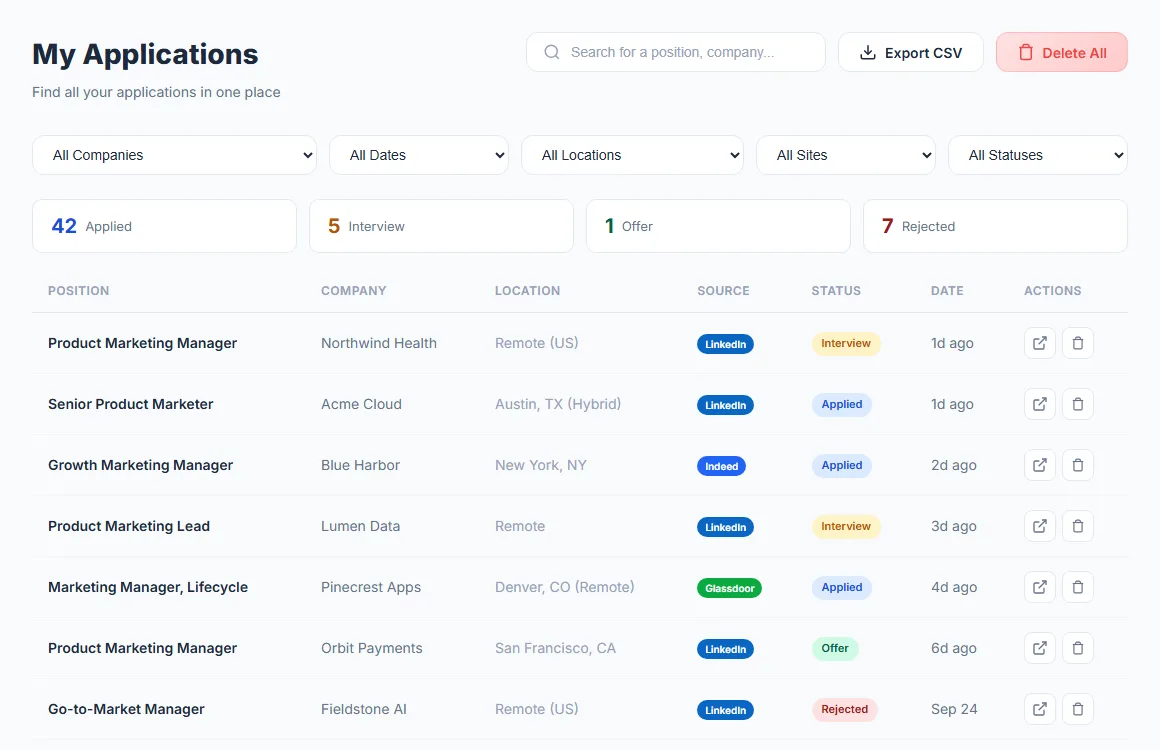
Follow-ups only work if you know which jobs you actually applied to and when. A tracker -- spreadsheet, Notion, or a purpose-built tool -- turns follow-ups from "did I already email them?" chaos into a 10-minute-a-day routine.
Prioritize follow-ups on your Tier 1 targets (dream companies, referrals, best-matched roles). If you're using an applied-100-jobs-per-day workflow, you don't need to follow up on all of them -- just the ones you'd genuinely accept an offer from. For post-interview messages, see our thank-you email after interview guide. If you're prepping for the call itself, our phone interview tips cover the first 5 minutes recruiters weigh most heavily.
FAQ
What is the best subject line for a follow-up email after applying?
Use "Following up -- [Job Title] Application" or "Checking in on [Job Title] role". Keep it under 45 characters so it doesn't truncate on mobile, and always include the job title so the recruiter knows what you're referring to without opening the email.
How long should a follow-up email be?
Keep it under 120 words -- 3 to 5 short sentences. Recruiters read hundreds of emails a day. A concise message that respects their time is far more likely to get a reply than a long pitch that restates your entire resume.
What do I write if I don't know the recruiter's name?
Open with "Hi [Team Name] team" or "Hello," rather than "To whom it may concern" -- the latter reads as generic and cold. Better yet, search LinkedIn for "[Company] recruiter" or "[Company] talent acquisition" and address them by name.
Is it OK to follow up on LinkedIn instead of email?
Yes, especially if you can't find an email address. Send a short personalized connection request mentioning the role you applied for. LinkedIn messages often get read faster than emails because the notification is harder to ignore.
How many times should I follow up before giving up?
Two follow-ups is the ceiling. Send the first at 5-7 business days after applying, the second at 10-14 business days if there's still silence. After that, move on -- silence is the answer, and continued messages will hurt your future chances with that company.