You’re applying to 500 jobs per week, and the average recruiter says you’ll get 4 interviews. That’s a 0.8% hit rate. The math is brutal, but the payoff—getting hired faster—makes the grind worth it. Here’s the exact framework that keeps you productive, prevents burnout, and turns bulk applying into a scalable career machine.
1. Map Your Target Landscape – 50% of the Work Is Knowing Where to Look
Before you hit “apply,” you need a data‑driven job map. In 2026, the top 10% of job boards by posting volume are:
- LinkedIn Jobs – 1.2M openings
- Indeed – 900K
- Glassdoor – 650K
- ZipRecruiter – 400K
- Dice (tech) – 250K
- AngelList (startups) – 180K
- Hired – 120K
- Remote.co – 90K
- FlexJobs – 80K
- CareerBuilder – 70K
Use a spreadsheet to flag the boards that match your industry, location, and salary expectations. For each board, record the average application time and the success rate (interview calls ÷ applications). This data will tell you where to focus 70% of your energy.
2. Build a Master Resume Stack – 1 Core, 3 Variants, 5 Templates
Hiring managers see dozens of resumes per day. To stand out, you need a modular system:
- Core Resume: One universal version that highlights your core achievements.
- Variant A – Technical: Adds tech stack keywords and project details.
- Variant B – Managerial: Emphasizes leadership metrics.
- Variant C – Remote: Highlights remote work tools and asynchronous communication.
- Template 1 – ATS‑friendly: Uses standard headings and no images.
- Template 2 – Designer‑friendly: For creative roles, a clean visual layout.
Store each file in a cloud folder with naming conventions like JohnDoe_Core_2026.pdf so you can pull the right one in seconds. Automate the file swap with a simple script that renames the PDF based on the job title keyword.
3. Automate Job Scraping – 20% of the Time Is Gathering Data
Set up a Python crawler that pulls job listings from your top boards every morning at 6:00 AM. Use the APIs where available; otherwise, rely on BeautifulSoup with a rate limit of 5 requests per second to avoid bans.
Filter the results with a rule set:
- Posted within the last 48 hours
- Remote or hybrid, if that’s your preference
- Salary ≥ $90K
- Keyword match: “data analyst”, “product manager”, “full stack”
- Company rating ≥ 4.0 on Glassdoor
Export the filtered list to a CSV. Each row should contain Job ID, Title, Company, URL, and Posting Date. This CSV becomes your batch application source.
4. Batch Apply with a Dedicated Tool – 30% of the Time Is Filling Forms
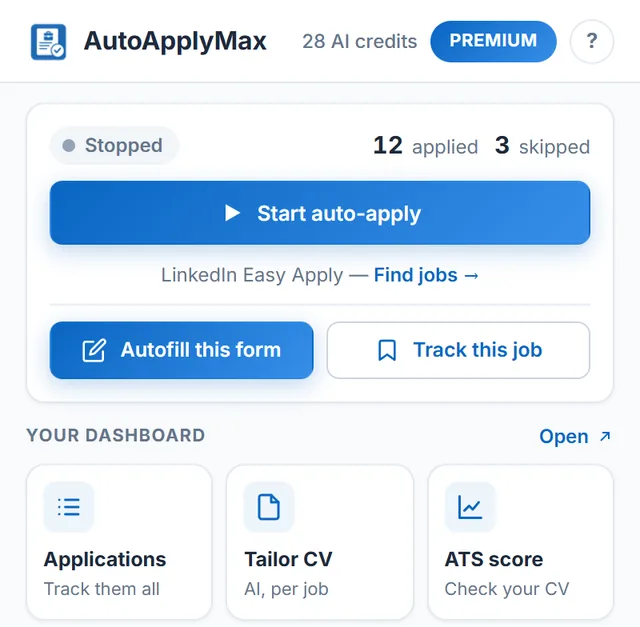
Use a “batch apply” service that supports LinkedIn, Indeed, and ZipRecruiter. The service reads your CSV and auto‑fills the application forms. Configure it to:
- Attach the correct resume variant based on the job title keyword.
- Insert a personalized cover letter snippet that mentions the company’s recent milestone.
- Set a maximum of 20 applications per minute to stay under the rate limit.
- Log each submission with a timestamp and status (submitted, pending, failed).
After the batch run, download the log. Review any failures manually; usually, they’re due to captcha or missing required fields. This step takes 15–20 minutes for 500 applications.
5. Optimize Your Cover Letter – 10% of the Time Is Writing
Instead of a generic letter, use a cover‑letter template that you tweak in 2 minutes per job:
- Open the template in a text editor.
- Replace the company name and the first line with a recent company news item.
- Insert a 2‑sentence STAR example that matches the job requirement.
- Save as JohnDoe_CoverLetter_CompanyName_2026.docx.
When the batch tool attaches the cover letter, it pulls the file name from the CSV field “CoverLetterPath.” This keeps the process frictionless.
6. Track Your Metrics – 10% of the Time Is Analysis
Every Friday, pull the application log and compute:
- Applications submitted (should be 500).
- Interview invitations (goal: ≥ 4).
- Offers (goal: ≥ 1).
- Average time to response.
- Board-wise success rate.
Store these metrics in a Google Sheet. Use conditional formatting to flag boards that fall below a 0.5% interview rate; those are candidates for removal from your focus list.
7. Manage Burnout – 10% of the Time Is Self‑Care
High‑volume applying is a marathon, not a sprint. Adopt these habits:
- Set a hard stop at 2 p.m. each day; no more applications after that.
- Take a 10‑minute walk after every 100 applications.
- Use a timer (Pomodoro) to keep focus and avoid fatigue.
- Schedule a weekly “no‑app” day to recharge.
- Track your mood in a journal; if you hit a streak of negative days, pause the batch.
Remember, a tired recruiter is a bad recruiter. Quality over quantity still matters.
Part of our job search guides: read how many jobs to apply to per week and what to do when you are not getting interviews.
Actionable next step: Get Your ATS Score
Check if your resumes are ATS‑friendly before you launch the batch.
Free ATS Check →8. Iterate and Scale – 10% of the Time Is Continuous Improvement
Every month, review the data and tweak one variable:
- Swap a low‑yield board for a new one.
- Change the resume variant for a specific role.
- Adjust the cover letter length from 200 to 250 words.
- Alter the application time window to avoid peak hours.
- Introduce a new keyword filter based on industry trends.
Track the impact of each tweak in the Google Sheet. The goal is to increase your interview rate by 0.2% per month while keeping the application volume steady at 500 per week.
By 2026, the high‑volume job application market will continue to evolve, but the core principles of data‑driven targeting, automation, and disciplined self‑care will remain the same. Apply the framework, stay consistent, and watch the numbers climb.
Remember, it’s not about applying to as many jobs as possible; it’s about applying to the right 500 jobs every week with precision and sustainability.