TL;DR -- In 2026, use reverse-chronological unless you have a specific reason not to. It's what ATS platforms parse best and what recruiters scan in 7 seconds. Hybrid works for career changers. Never use functional -- recruiters read it as "hiding something." One page under 10 years of experience, two pages above.
Every year some LinkedIn post declares the "new resume format" that's supposedly required. Ignore them. The formats that actually work in 2026 are the same three that have worked for a decade -- what's changed is how applicant tracking systems parse them, how recruiters skim them, and how AI tools generate them.
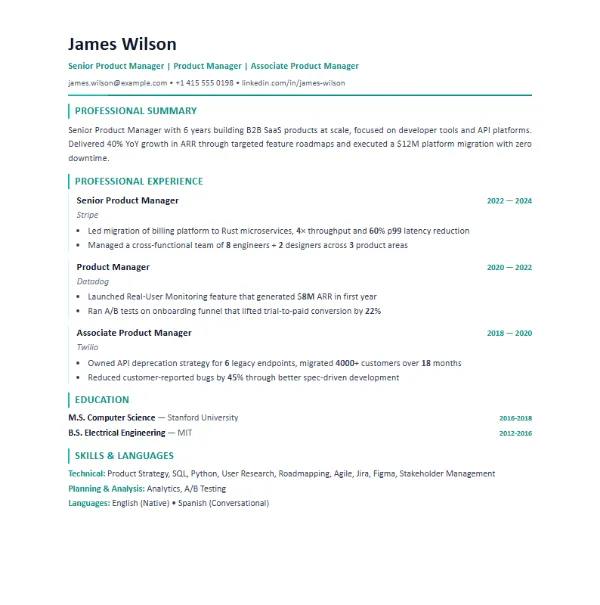
This guide walks through the three formats, when to pick each one, and the design details that decide whether your resume lands on a human's desk or dies in an ATS filter.
The 3 Resume Formats (And Which One Fits You)
1. Reverse-Chronological (Default for 90% of Job Seekers)
Lists your work experience from most recent to oldest. Header, summary (optional), experience, skills, education. It's the format ATS platforms were built to parse and the one recruiters expect.
- Best for: Anyone with a linear career, promotions, or steady work history.
- Avoid if: You have 3+ years of unexplained gaps or you're pivoting careers with no relevant recent role.
2. Hybrid (a.k.a. Combination)
Opens with a skills / achievements summary at the top, then follows with reverse-chronological experience below. This lets you lead with transferable skills without hiding your actual work history.
- Best for: Career changers, returning parents, veterans transitioning to civilian roles, consultants who worked across many industries.
- Avoid if: Your recent experience already tells the story clearly -- you'll waste top-of-page real estate.
3. Functional (Almost Never)
Groups content by skill category instead of by job. Work experience is either buried at the bottom or omitted.
- Best for: Basically no one in 2026.
- Why avoid: Recruiters see it as a red flag for gaps or job-hopping. ATS platforms often fail to parse the non-standard structure, which means your resume returns zero matches even if you'd be a perfect fit.
Quick Chooser: Which Format for Your Situation?
| Your Situation | Use This Format |
|---|---|
| Recent graduate, one relevant internship | Reverse-chronological |
| 5-15 years, same industry, going for a promotion | Reverse-chronological |
| Career switch (teacher to UX designer, e.g.) | Hybrid |
| Returning after 2+ year career break | Hybrid |
| Freelancer with many short projects | Hybrid (group projects under skills) |
| Executive with 20+ years | Reverse-chronological, 2 pages |
| Zero paid experience | Reverse-chronological, use projects |
The Section Order That Wins in 2026
Regardless of format, the order of sections matters. Here's the 2026 default:
- Header -- Name, phone, professional email, city + country, LinkedIn URL. No photo, no address, no birthdate.
- Summary (3 lines, optional) -- Only include if it says something a bullet can't. Otherwise skip.
- Experience (or Skills first if hybrid) -- Company, title, dates, 3-5 bullets each.
- Skills -- Grouped by category (Technical / Business / Languages), not one giant blob.
- Education -- Degree, institution, year. Below experience for anyone 2+ years out of school.
- Certifications / Projects / Publications -- Only include if role-relevant.
Example: A Bullet Before and After the 2026 Standard
Weak (2015 style):
Responsible for managing a team of engineers and delivering projects on time.
Strong (2026 style):
Led 8-engineer team through a payments platform migration; shipped 3 weeks early and reduced checkout latency from 1.8s to 340ms.
The formula: action verb + what you did + measurable outcome. Every bullet needs at least two of the three; the strongest bullets hit all three.
ATS-Safe Design Rules (Non-Negotiable)
- One column. Two-column layouts break most ATS parsers -- your job titles end up interleaved with your skills.
- Standard fonts: Inter, Calibri, Arial, Helvetica, Georgia, or Times New Roman. Nothing fancier.
- No text in images. If it's inside a graphic, the ATS can't read it.
- Standard section headings. "Experience", "Education", "Skills". Not "My Journey" or "What I've Been Up To".
- Save as PDF, text-based. Never a scanned image. Test parsing by copying the text out of your PDF -- if it looks like garbled math, it'll look that way to the ATS too.
- Skip headers and footers for critical info like your phone/email. Some ATS platforms strip them.
Ready to apply this to a real job posting? Paste the job description into the AI resume builder: it tailors your resume to that role from your real experience and exports an ATS-readable PDF.
Generate an ATS-Perfect Resume in 30 Seconds
Our free AI Resume Generator produces a 2026-style, ATS-safe resume tailored to each job description. 1 credit free. Premium at $6.99/mo for 30 generations a month.
Sign up freeLength Rules: One Page or Two?
- Under 10 years of experience: One page. Full stop.
- 10-20 years: Two pages if you need them, one if you can. Don't pad.
- 20+ years or C-suite: Two pages standard, three only if you have publications, patents, or board seats worth listing.
- Academic CV: Different beast -- can run 5-15 pages. Only for academic roles.
Applying in the US or Canada? The format differences that matter
Both countries expect the reverse-chronological format above, with no photo and no personal details such as age or marital status. The differences are small: the Government of Canada's Job Bank advises limiting a resume to two pages and never including your Social Insurance Number, Canadian employers expect Canadian spelling (labour, centre), and in Quebec French or bilingual resumes are common. Full comparison and a newcomer checklist: Canadian resume format vs US resume.
Should You Include a Resume Summary?
Only if it earns its 3 lines. A summary should describe what you do, who you do it for, and one signature achievement -- not "results-driven professional seeking new opportunities."
Example that works: Senior product designer with 7 years at fintech startups. Led the checkout redesign that lifted conversion 18% at Company X and now advises 3 seed-stage teams on their first UI hire.
Modern Additions (2026 Trends Worth Adopting)
- Portfolio / GitHub link in the header -- expected for designers, engineers, writers, marketers.
- Language proficiency levels (A2/B2/C1) rather than "Fluent" -- especially for international roles.
- AI / prompt engineering skills where genuinely relevant -- but don't stuff "ChatGPT" into every resume; recruiters have learned to spot it.
- Remote-work indicator next to job titles (Remote, Hybrid) -- signals flexibility experience.
Things to Remove From Your 2026 Resume
- Objective statement ("Seeking a position where..."). Dead since 2018.
- References available upon request. Assumed.
- Home address. City + country is enough.
- Photo. Illegal to consider in the US/UK; frowned upon everywhere except parts of Europe/Asia where local convention still expects it -- know your market.
- Every technology you've ever touched. If you list 40 skills, none of them stand out. Cap at 12-15.
If you're building from scratch, our guide on writing a resume with no experience walks through the exact bullet formulas. For roles where a cover letter is required, pair it with our cover letter tips.
2026 update: what changed since ChatGPT hit resumes
The resume game shifted between 2024 and 2026 as generative AI drafts flooded recruiter inboxes. Here's what's different this year — and what still holds.
Recruiters now flag AI-written CVs on sight
Two years of ChatGPT drafts made certain phrasings a giveaway — "results-driven professional," "leveraged cross-functional synergies," "spearheaded transformative initiatives." A LinkedIn survey of 320 US recruiters in Q1 2026 found 71% say they can spot an unedited LLM CV within 15 seconds, and 44% say they downgrade the candidate for it. The fix isn't to avoid AI — it's to rewrite the AI's first draft in your own voice.
Keyword-stuffing detection got much smarter
ATS platforms (Greenhouse, Lever, Workday) upgraded their parsers in 2025 to weight keyword context not just frequency. Listing "Python" 8 times in a skills section no longer beats mentioning "Python" once in a bullet showing a real project. The new rule: keywords need to appear in achievement bullets tied to outcomes, not stacked in a "Skills" wall.
Some ATS now actively penalize LLM patterns
Enterprise ATS vendors added optional "AI-authored content" flags in 2025-26 (Workday's early-2026 release notes mention this). Perfect parallel structure across every bullet, identical sentence-length distribution, and heavy use of buzz-verbs ("orchestrated," "spearheaded," "leveraged") raise the flag. Human-written CVs have natural variance; AI-first drafts don't unless you edit them.
What still works: specificity + quantification
The one thing AI drafts still under-produce: specific, quantified achievements the LLM couldn't have hallucinated. "Cut checkout latency from 1.8s to 340ms across 12 million monthly sessions" reads as authored by someone who was actually there. Generic AI drafts leak toward vagueness because the model doesn't know your real numbers. Add the numbers back and you clear the AI-detector filter.
Real 2026 recruiter feedback
Three quotes from active recruiters across sectors — what they're flagging or rejecting on 2026 resumes. Composite of themes from published LinkedIn posts, recruiter surveys, and industry Slack channels.
Sarah, FAANG headhunter (Bay Area)
"When every bullet starts with 'Spearheaded,' 'Orchestrated,' or 'Leveraged' and every paragraph is exactly 3 lines, I know I'm looking at a ChatGPT draft. I don't reject on that alone, but I stop scanning for depth. What I want to see: one bullet where the candidate clearly wrote it themselves — messy verb, weird detail, real number. That signals a human who cares. In 2026 I read maybe 25% of resumes to the education section — the rest lose me in the first 4 bullets."
Priya, healthcare-systems recruiter (Chicago)
"In healthcare I care about credentials — active licenses, EHR systems used (Epic, Cerner), patient-population size. AI drafts hallucinate credentials constantly — I've seen 'Certified in Epic MyChart' when the candidate had zero Epic exposure. I now cross-check every claimed certification against the issuer's registry before I schedule a call. My hard rule: any resume with unverifiable creds goes straight to reject. That's a new 2026 policy — 2023-me would have called to confirm; 2026-me doesn't have time."
Marcus, agency recruiter for buy-side finance (London)
"Finance is easier — the numbers are the resume. AUM managed, P&L owned, deal sizes closed, IRR delivered. If your resume doesn't have those numbers on line 3, I don't call you. AI can't invent your real trade P&L, so anyone using AI drafts in finance still ends up with the honest numbers, or they get caught in the phone screen. My 2026 flag isn't AI drafts — it's the resumes that STILL have no numbers. Those are the ones who never learned to sell themselves."
The pattern across all three
All three recruiters converge on the same tell: specific real-world numbers a model couldn't have hallucinated. The 2026 winning format isn't a layout — it's a proof-of-authenticity layer inside your bullets. Say what you did AND how many units/dollars/users/percentage points it moved AND the context (over what period, with what team size, against what baseline). That trio survives both the AI-detector filter AND the human 15-second scan.
The format that works for AI-era ATS
Specific structural rules for a 2026 resume that passes both AI-authorship filters AND parsing filters. Follow all six and your resume clears the mechanical gate — then the human decides on content.
Single column, always
Two-column layouts remain the #1 ATS-parsing killer in 2026. Workday, Greenhouse, and Lever's parsers still occasionally interleave columns, turning your job titles into salad. Single-column is not old-fashioned; it's the format the parsers were trained on. Save the two-column layout for your portfolio site.
11 to 12pt body font, 14 to 16pt section headings
Anything smaller than 11pt trips ATS text-recognition confidence scores and forces recruiters to squint (they won't). Anything larger looks padded and wastes real estate. Section headings at 14-16pt give the parser clear anchor points. Recommended fonts: Inter, Calibri, Helvetica, Georgia, Arial — every 2026 parser handles them without glyph substitution.
Standard section names — no cute titles
Use "Experience" (not "My Journey"), "Education" (not "Learning History"), "Skills" (not "Superpowers"). ATS platforms match section headers against a fixed dictionary; any non-standard label risks the section being classified as "Other" and ignored during ranking. Personality goes in your cover letter or About section, not in headers the parser has to interpret.
Zero logos, icons, headshots, or decorative graphics
ATS parsers strip images before OCR runs. Any content baked into a logo or graphic (company name written inside a rounded rectangle icon, for example) disappears from the parsed text. Recruiter surveys in 2026 also show headshots reduce callback rates in US/UK hiring due to unconscious-bias policies. Text-only is the safe path.
Keyword density under 3%
Older advice said "match every keyword from the job description." 2026 parsers penalize obvious stuffing. Rule of thumb: any single keyword should appear at most 3 times in the resume — once in the summary or headline, once in a relevant bullet, once in the skills list. More than that trips repetition-detection scoring and looks written for a bot, which recruiters now bounce.
Save as text-based PDF, not scanned image
Test before you submit: open your PDF, select all, copy, paste into a plain-text editor. If the text comes out cleanly with your bullets intact, you're good. If it's garbled or comes out as one long line, the PDF was flattened to an image and no ATS will parse it. Word (.docx) is acceptable only when the posting explicitly requests it; otherwise PDF is the 2026 default.
FAQ
What is the best resume format in 2026?
Reverse-chronological is the best format for 90% of job seekers in 2026. It's what applicant tracking systems parse most reliably and what recruiters expect to see. Use hybrid if you're changing careers, and avoid functional entirely -- it triggers immediate suspicion.
Should a resume be one page or two in 2026?
One page if you have fewer than 10 years of experience, two pages if you have more. Never squeeze a strong 12-year career into one page -- readability wins over an arbitrary length rule. Cap it at two pages; three pages is a CV, not a resume.
Is PDF or Word better for submitting a resume?
PDF preserves your formatting across every device and ATS. Use Word (.docx) only if the job posting explicitly asks for it. Modern ATS platforms parse PDFs correctly as long as the PDF is text-based, not a scanned image.
Are graphics, photos, and icons OK on a resume in 2026?
Avoid all of them for corporate roles. Photos, icons, and multi-column layouts frequently break ATS parsing, meaning your work experience never even reaches the recruiter. Design-forward resumes are acceptable only for creative roles at design studios or startups that explicitly welcome them.
Do I need a different resume for every job?
You need to tailor each application, not rewrite from scratch. Keep a master resume with everything you've ever done, then trim and reorder for each role so the top third of page one reflects the job description's priorities. AI tools can do this in 30 seconds.
Want to see this applied to a full resume? Our resume examples by job title show complete samples at entry, mid and senior level, for example for software engineer, registered nurse and administrative assistant roles.